

If you drive through west Cambridgeshire today, the site of RAF Molesworth does not announce itself in the way a former WW2 flying station once did. The landscape is still flat enough to make sense of runways, but the old airfield architecture and layout has been broken up: hedges, lanes, a few stubborn buildings, and then modern compounds doing a very different kind of work.
That odd mix is the point. RAF Molesworth had three lives: a short First World War one; a Second World War life that became properly significant; and then a slow unpicking of an airfield that, by the early 1970s, had stopped being an airfield at all.
RAF Molesworth is now a non-flying US Air Force (USAF) facility in Cambridgeshire, UK, primarily home to the Joint Analysis Center (JAC) (also known as the NATO Intelligence Fusion Centre).
RAF Molesworth’s WW2 history
Molesworth lies near Old Weston, with Brington and Molesworth villages close by. In wartime terms it was well-placed: away from the coast, but with a straight shot to the North Sea and the continent for WW2 bombers. In peacetime terms it was farmland, which is exactly why it could be taken, levelled, drained, fenced, and then later returned, in part, to agriculture. A lot of East Anglia’s airfields share that pattern, but Molesworth is a good example because you can still see the joins between each phase.
The history of this historic WW2 airfield can be traced back further than the Second World War.
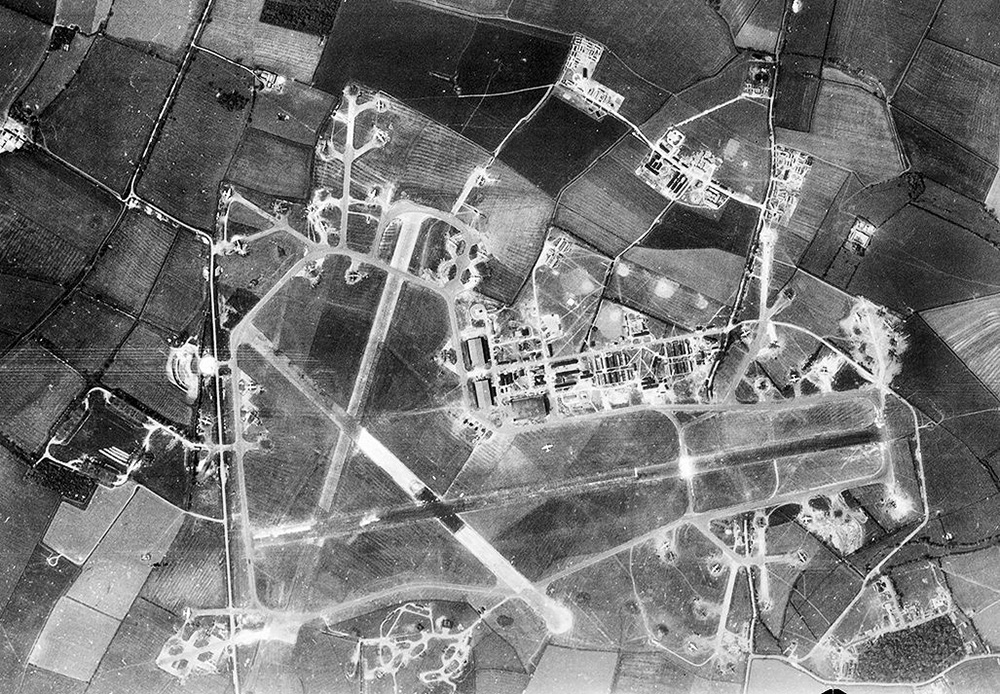
1917: a useful field, not a permanent station
Molesworth first appears in the air war as a Royal Flying Corps landing ground in 1917. It was not a grand “base” in the later sense. It was chosen as a site for an airfield near Old Weston, used for training and pilot proficiency, then dropped back into disuse as the war moved on.
The first unit associated with the site was No. 75 Squadron, flying the Royal Aircraft Factory B.E.2. By 1917 the B.E.2 already felt like yesterday’s machine in a quickly changing air war. At Molesworth it served in the quieter, necessary business of instruction, familiarisation and keeping aircrew competent before postings elsewhere. The squadron remained until September 1917, and then the place fades from the front rank of records.
That “fade” matters. In the First World War the RFC used a lot of temporary grounds. Some grew into permanent stations. Many did not. Molesworth, in its first iteration, was the latter.
1940–41: building a RAF station for a new kind of war
The Second World War brought Molesworth back, properly. The Air Ministry selected the area for what became RAF Station Molesworth, built between 1940 and 1941. This time the intent was clear: a modern station capable of supporting large-scale operations, not a convenient training field.
Late 1941 to early 1942: the Commonwealth interlude
No. 460 Squadron RAAF
On 15 November 1941, No. 460 Squadron RAAF formed at RAF Molesworth, equipped with Vickers Wellington Mk IV bombers. It did not stay long. It moved out in early January 1942, part of the wider shuffle as Bomber Command expanded, reorganised and pushed units towards their operational roles.
This is an important stage because it shows RAF Molesworth’s history as part of the wartime machinery before the American phase. It is also, quietly, the moment the station begins to feel like what it was built to be: a place where crews arrive as strangers and leave as a unit, often before the local area has learned their faces.
No. 159 Squadron RAF
No. 159 Squadron RAF was reformed at RAF Molesworth in early 1942, but in a way that underlines how wartime paperwork and movement can matter as much as flying. The squadron’s story quickly leads away from Cambridgeshire into other theatres.
So why does it matter in a RAF Molesworth history? Because it shows how the station sat in a pipeline. Molesworth was not only a “home” for a unit; it could also be a staging post where an organisation was assembled, named, and then posted into a completely different war.
1942: RAF Molesworth becomes an American station
In 1942, RAF Molesworth was allocated for use by the United States Army Air Forces (USAAF) as part of the build-up of the Eighth Air Force in Britain. The station was developed to meet American requirements and given a US station designation as Station 107.
This is the practical side of alliance warfare. The RAF had the airfields and experience running them under attack. The Americans arrived with aircraft, people, and very specific ideas about runway length, dispersal, and standardisation. Molesworth’s physical form began to tilt towards that American way of doing things. It now became a Class A airfield, as the runways were extended to American specifications for heavy 4-engined bombers. The main runway was increased in length to 2,000 yards and the number of hardstands in which the aircraft could sit, was increased to fifty.
June to September 1942: the 15th Bomb Squadron and a symbolic first blow
The first US Army Air Forces unit to operate from Molesworth was the 15th Bombardment Squadron (Light). It arrived in June 1942 and flew a mix of aircraft types during a period when the Americans in Britain were still building an operational footing.
On 4 July 1942, American crews flying alongside an RAF squadron carried out a low-level strike against Luftwaffe airfields in the occupied Netherlands. It is often described as the first USAAF bombing attack on mainland Europe from Britain. The detail matters less than the meaning: the US Eighth Air Force had entered combat in a way that could be reported, understood, and turned into a shared moment between allies. It was not theatre. Aircraft were shot down and men did not return.
By mid-September 1942 the squadron moved to another station. The RAF Molesworth phase was short, but it set the tone: this airfield was now part of a much larger American presence that would soon arrive in bulk.
September 1942 to 1945: the 303rd Bomb Group, “Hell’s Angels”, and the long bomber war
When people say “RAF Molesworth” in a Second World War context, they usually mean the 303rd Bombardment Group (Heavy). From late 1942 to 1945 it was the long-haul tenant, flying the B-17 Flying Fortress as part of the daylight bombing force.
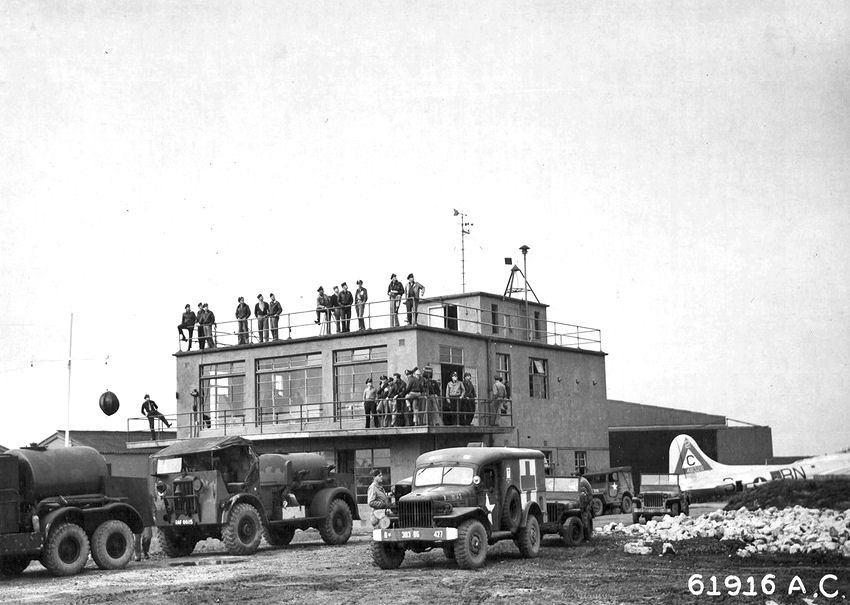
What a “Group” meant, and why it mattered
A USAAF heavy bomber group was built to generate sorties at scale. Four squadrons gave it resilience: crews and aircraft could be rotated, maintenance loads spread, losses absorbed, and the organisation kept moving. At RAF Molesworth those squadrons were the 358th, 359th, 360th and 427th Bomb Squadrons.
The nickname “Hell’s Angels” became closely tied to the group’s identity. It is one of those labels that has outlived the war itself.
November 1942: first operations
The group’s first mission was flown on 17 November 1942 against targets in occupied France. That matters less for the target list than for what it represents: an organisation shifting from training into operational rhythm, learning the mechanics of take-off, assembly, navigation, bomb run, flak, fighters, damage, recovery, and the rapid reset required to do it again.
January 1943: into Germany proper
On 27 January 1943, the group took part in the Eighth Air Force’s first heavy bomber attack against a target in Germany, striking Wilhelmshaven. It marks a new stage: daylight bomber formations into the Reich without yet having full escort cover.
It is best not to treat that moment as a neat step forward. Early 1943 raids were full of compromise: weather, mechanical trouble, navigation error, cohesion problems, and the limits of radio. Losses could spike even when the plan looked sound on paper. In that sense, RAF Molesworth airfield’s story is not separate from the wider Eighth Air Force story. It is a local address for it.
A captured fortress: Wulfe Hound
On 12 December 1942, a B-17 of the 303rd Bomb Group, nicknamed Wulfe Hound, was forced down in France and ended up in German hands. The significance is obvious. It is one thing to lose an aircraft and crew. It is another to lose an aircraft intact enough to be examined, copied, and used for intelligence.
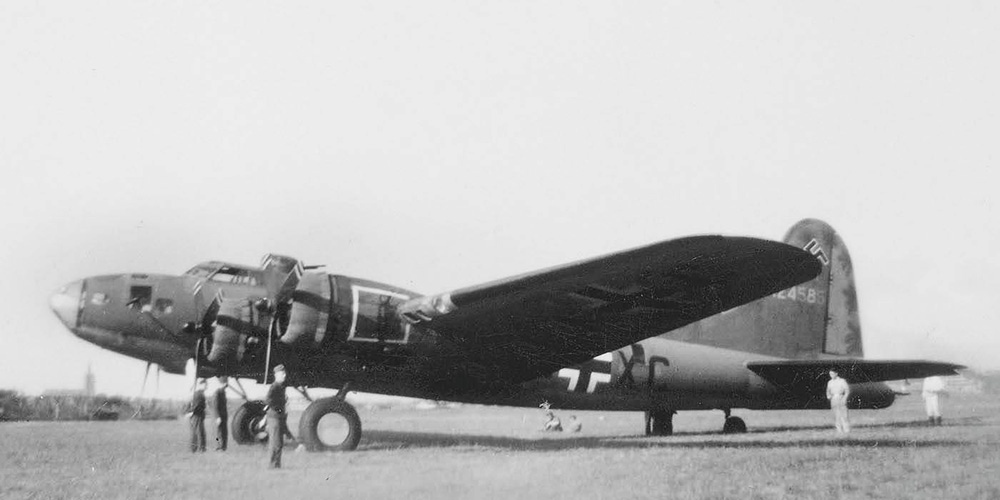
Even without dramatising it, you can see how it would land at RAF Molesworth. Crews swapped rumours as much as they swapped maps. A missing aircraft might mean a crash at sea, a prison camp, or an intact bomber parked up for the enemy’s technicians. That uncertainty was part of the strain.
The crew was captured, and the men became POWs.
1943–44: the grind and the public face of a bomber base
As the campaign expanded through 1943 and into 1944, the target set broadened with it: industry, ports, marshalling yards, aircraft production, and the systems that kept the German war economy moving. The work was repetitive in the way only industrial war can be. Take off. Form up. Cross water. Face flak. Face fighters. Fly home damaged. Patch the aircraft. Replace the crew. Do it again.
But RAF Molesworth was not only a place where targets were assigned and bombs were loaded. It also carried the need to look manageable to the people living on it and to the people watching from home.
Entertainers came through. So did journalists, because daylight bombing was a public war. That public attention mattered. It shaped how missions were described, how losses were framed, and how the bomber force was sold as both necessary and bearable.
1944–45: supporting the land war, then closing the book
By 1944 the bombing campaign was tied directly to invasion planning and then to supporting armies on the ground. The group attacked transport links, defensive positions and other military targets as the focus shifted toward enabling the invasion and sustaining the push across Europe. Later, as the front moved, the targets moved with it.
The 303rd’s final combat missions came in April 1945. Soon after, the group left RAF Molesworth. The station that had spent years launching aircraft into a very particular kind of war suddenly had no clear reason to exist in its wartime form.
Station life and local impact: what changed around Old Weston
A heavy bomber group did not sit lightly on the countryside. Thousands of men, vehicles, fuel deliveries, practice flights, accidents, noise, rationing, blackouts, a construction workforce, then steady movement in and out. The station became a presence that nearby villages could not ignore.
There is also the personal side, less tidy than operational records. Wartime bases brought young men into close proximity with small communities. Some relationships were brief. Some lasted. The broader story of Anglo-American marriages belongs to many stations across Britain. With RAF Molesworth, it is safer to say that it shared in that wider pattern, rather than to repeat any “most of anywhere” claim without a documented count.
After 1945: winding down and losing the runways
After the war, RAF Molesworth did not snap back to farmland overnight. Britain did not have the spare capacity for neat endings. The station had a short post-war afterlife with other Allied units passing through, and then its flying role diminished.
By the early 1970s, Molesworth had stopped being an operational flying airfield. The physical stripping out of runways and wartime concrete happened in stages afterwards. If you want one clean way to put it: the airfield’s working flying life ended in the 1970s, and the runway removal and major demolition followed later as the site was broken up and repurposed.
Post 1970’s history: from runways to analysis
By 1973, Molesworth’s runway and flying facilities had been closed and the airfield began to be broken up. The site did not fall quiet for long, though. In the early 1980s it was rebuilt for a very different purpose, supporting the ground-launched cruise missile programme. Alongside Greenham Common, it became one of the two British bases associated with cruise missiles and, inevitably, a focal point for protest.
What remained at Molesworth was no longer an air station in the traditional sense. It became a non-flying facility under United States Air Force control, part of the Cambridgeshire “Tri-Base Area” with RAF Alconbury and RAF Upwood, whose close proximity made them interdependent until Upwood closed in 2012. In a small historical irony, two of the last active Second World War-era Eighth Air Force airfields in Britain ended up continuing their service lives in the Cold War and beyond. The arc reaches right back to 4 July 1942, when US crews flying from Molesworth took part in the first Eighth Air Force mission over German-occupied Europe.
Today, Molesworth’s role is firmly in intelligence rather than aviation. The base houses the Joint Intelligence Operations Center Europe Analytic Center and supports a number of units associated with the 423rd Air Base Group.
