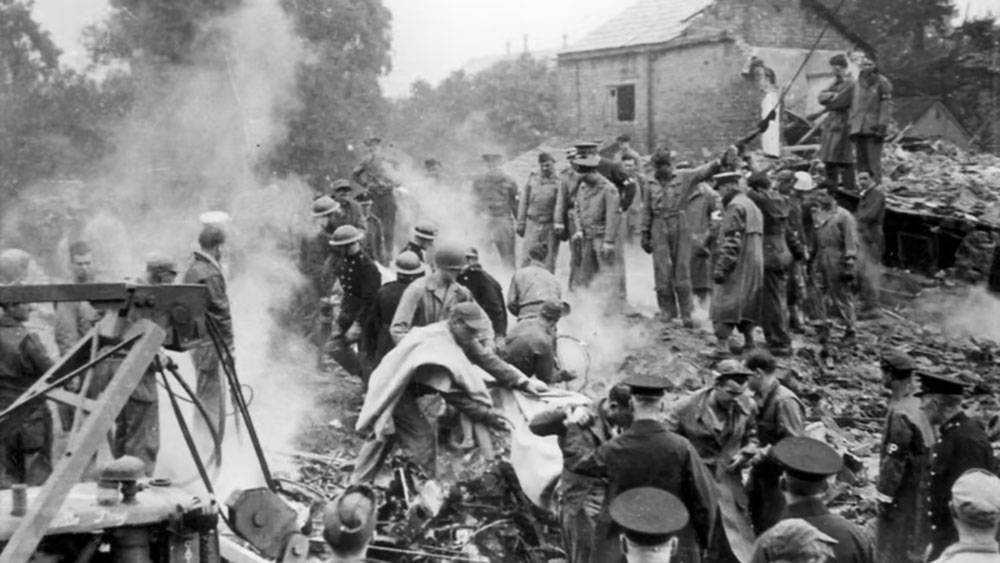
On the morning of 23 August 1944, a United States Army Air Forces B-24 Liberator bomber on a test flight lost control in a violent thunderstorm and crashed into the centre of Freckleton, a village of near RAF Warton in Lancashire. In seconds, the aircraft obliterated houses on Lytham Road, destroyed a popular café and ploughed into the infants’ wing of Holy Trinity School.
Sixty-one people died: three aircrew, thirty-eight children aged four to six, two teachers, and a mix of British civilians and American and RAF servicemen on the ground. It remains one of the worst home-front air disasters suffered by the Allies in the Second World War.
This is the story of the Freckleton air disaster – the setting, the flight, the victims and survivors, and how a small Lancashire village has remembered its lost children ever since.
Freckleton in wartime: a small village beside “Little America”
By 1944, Britain had been at war for nearly five years. The Fylde coast of Lancashire was dotted with airfields and military sites, and just outside the village of Freckleton stood a vast American base: USAAF Base Air Depot 2 (BAD-2) at RAF Warton.
BAD-2 was one of the largest USAAF maintenance and repair depots in Europe where thousands of American personnel passed through to service and refit aircraft for the Eighth Air Force. The scale of the operation, and the presence of so many American accents, and a snack bar, led locals to call it “Little America”.
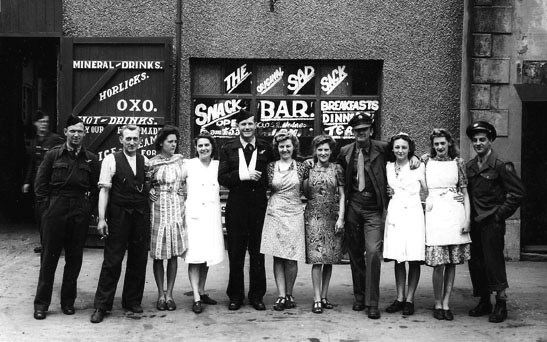
Freckleton itself was a modest agricultural village. Children walked to Holy Trinity Church of England School on Lytham Road; villagers shopped at small local businesses and, increasingly, at places catering to the Americans. One of these was the “Sad Sack” Snack Bar – a café on Lytham Road popular with US airmen, RAF personnel and locals alike.
Against this backdrop of intense military activity and apparently routine flying, the events of 23 August 1944 unfolded.
The aircraft: B-24 Liberator “Classy Chassis II”
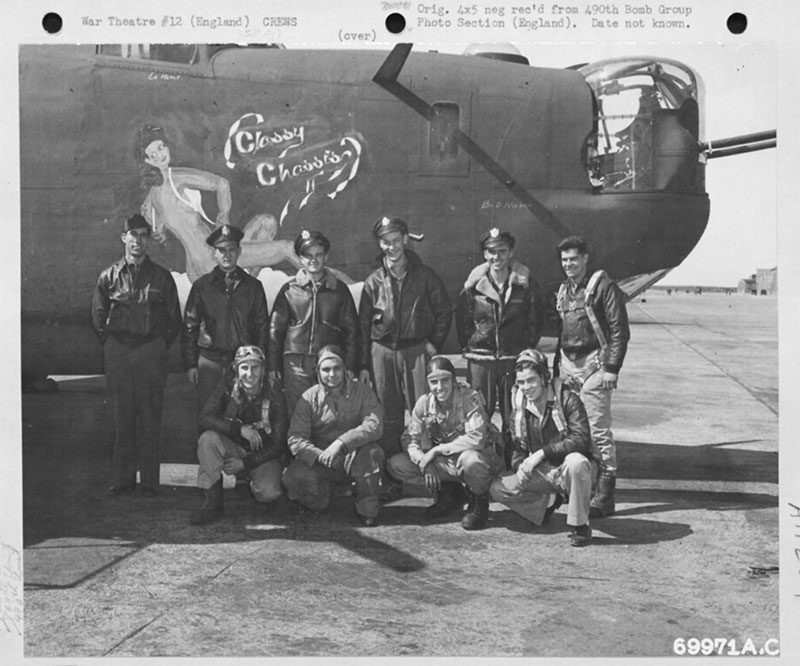
The aircraft at the heart of the Freckleton air disaster was a Consolidated B-24H-20-CF Liberator, serial number 42-50291, nicknamed “Classy Chassis II”. Built in Fort Worth, Texas, this heavy bomber had already seen combat in 1944 with the 486th Bomb Group, taking part in bombing missions over occupied France. That summer, “Classy Chassis II” was sent to BAD-2 at Warton for repairs and refurbishment before being returned to active service. As with many aircraft processed at Warton, it needed a test flight after work was completed.
The crew
On 23 August 1944, three experienced airmen crewed the test flight:
- 1st Lt John A. Bloemendal – pilot and officer of the day at BAD-2, with more than 700 hours as a test pilot, over 250 of them on B-24s.
- T/Sgt Jimmie Parr – co-pilot.
- Sgt Gordon H. Kinney – flight engineer.
It was intended to be a routine local test involving a short hop out of Warton, a systems check, and then back to base.
The morning of 23 August 1944: gathering storm
The test flight was originally scheduled for around 8.30am, but a last-minute call required Lt Bloemendal elsewhere on base, so the sortie was postponed by about two hours.
By mid-morning, the weather was changing. From the nearby Burtonwood weather station came a warning of a violent thunderstorm moving toward the area. Staff at BAD-2 were told of an approaching “thunderhead”, a towering cloud mass signalling extreme conditions.
Nevertheless, two refurbished B-24s, including “Classy Chassis II”, took off from Warton on their test flights at about 10.30am, climbing to around 1,500 feet and heading north. The aircraft had full complements of fuel onboard for testing purposes. Sadly, this would contribute to the scale of the disaster to come. A short while later, as the storm grew rapidly in strength, the base issued urgent orders: both aircraft were to return and land immediately.
On the ground, people noticed the sudden change. The bright summer morning darkened as thunderclouds rolled in. One child later remembered the sky turning “as dark as night” and classroom lights being switched on so the infants could see their work.
Holy Trinity School: an ordinary morning
Holy Trinity School stood very close to Lytham Road, a stone’s throw from the Sad Sack Snack Bar. The infants’ section where the youngest children, aged four to six, were taught, was housed in a single-storey aspect to the school.
On that Wednesday morning, the infants were settling into their routine. Two teachers were in charge:
- Miss Jennie Hall, just 21 and newly qualified, teaching a class of five- and six-year-olds.
- Miss Louisa Lee Hulme, a more senior teacher nearing retirement, with the four-year-olds.
The partition between their classrooms could be folded back for assemblies and stories; that morning, the children were reportedly preparing for lessons when the storm darkened the sky. In the junior classrooms in another part of the building, older children carried on with their work, watching the rain lash the windows.
The crash: seconds of chaos
At about 10.41am, both B-24s were ordered to land on runway 08 at Warton due to the stormy weather. The pilots lowered their landing gear and began their approach in increasingly turbulent conditions.
One of the Liberators, flown by Lt Manassero, descended safely and managed to land. “Classy Chassis II”, piloted by Lt Bloemendal, was following behind, but almost immediately ran into the worst of the storm. Witnesses described blinding rain, violent gusts and extremely poor visibility.
In the sheeting rain, the aircraft was seen emerging from low cloud in a steep, banking turn near the village. Moments later, at about 10.47am, it struck the ground in Freckleton itself.
Impact on Lytham Road, the Sad Sack Snack Bar and the school
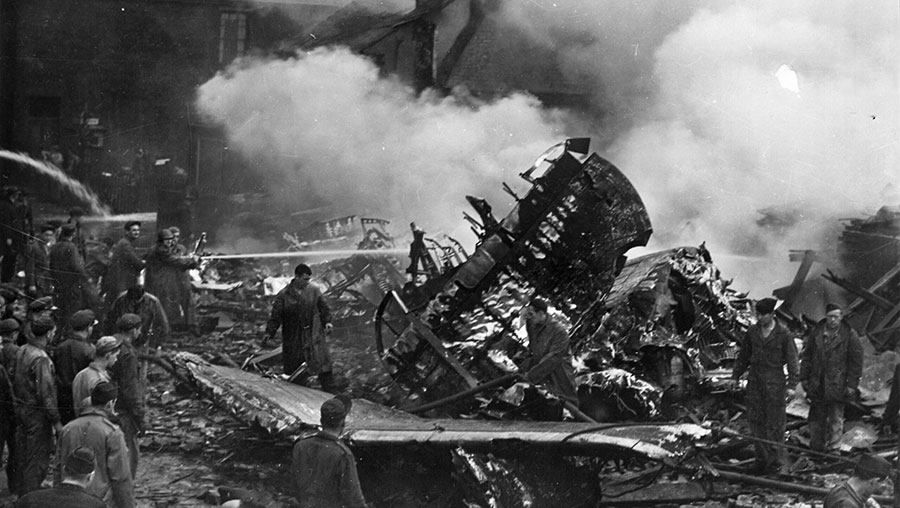
The B-24 came down almost vertically, its right wing clipping and demolishing buildings along Lytham Road. Three houses were destroyed. The wing and parts of the fuselage smashed into the Sad Sack Snack Bar, obliterating the café and killing everyone inside.
Still moving forward, the rest of the aircraft, laden with an almost full complement of fuel, ploughed into the infants’ wing of Holy Trinity School. The impact and immediate explosion sent a fireball of aviation fuel through the classrooms. Teachers, children, desks and partitions were engulfed in flame and debris.
A clock in the wrecked school stopped at the moment of impact: 10.47am.
Inside the classroom: voices of the children
Only a handful of the infants in the classrooms survived. One of them was four-year-old Ruby Whittle (later Ruby Currell). Her memories, shared many decades later, give an extraordinarily vivid sense of those seconds:
She remembered the storm making the room so dark that the teacher put the lights on. Then, without warning:
“All of a sudden it was noise, and I saw the teacher fall over. I looked over and saw a girl fall, and when she fell out of her desk I dived under mine.”
Ruby’s decision to hide under the desk almost certainly saved her life. Even so, she suffered severe burns and injuries and would spend months in hospital.
Other children in the junior classrooms felt the shock as a roar, an impact and then darkness and dust. Those who escaped unhurt or with minor injuries emerged into a scene of chaos, fire and smoke, plus the knowledge, over the days that followed, that brothers, sisters and friends were missing.
Casualties: the scale of loss
Victims of the Freckleton air disaster numbered sixty-one people in total:
- 3 USAAF aircrew (all aboard “Classy Chassis II”)
- 38 children aged four to six
- 2 teachers from Holy Trinity School
- 7 American servicemen on the ground
- 4 RAF airmen
- 7 civilians (including café staff, owners and customers, and residents of the demolished houses)
Almost five percent of the village’s population died that morning. Among the children, seven were first or second cousins to each other. Three were evacuees from the London area who had been sent to the village for safety from German bombing. Only one evacuee child survived.
The school victims of the Freckleton air disaster
Within Holy Trinity’s infants’ classrooms, the impact was almost total. Thirty-four children and one teacher were killed instantly; four more children and teacher Louisa Hulme died later in hospital from their burns and injuries, bringing the school death toll to thirty-eight children and the two teachers.
Miss Jennie Hall, only 21, and Miss Louisa Lee Hulme, in her 50s, both succumbed to their injuries despite efforts to save them.
The Sad Sack Snack Bar and nearby houses
The casualty lists show the names of those killed in the snack bar and adjacent houses. Victims were a mix of local civilians, RAF airmen and US servicemen. Among them were:
- Allan and Rachel Whittle, owners of the Sad Sack Snack Bar.
- Pearl Whittle, 15, who worked there.
- Gwendolyn Franken and Evelyn Rhodes, snack bar staff.
- James Victor Silcock, 15-year-old customer.
- RAF Sergeants Walter W. Cannell, Robert J. Bell, Eric C. W. Newton and Douglas Batson, who were in the café at the time.
- Several US servicemen, including Sgt Frank L. Zugel, Cpl Herbert G. Cross, Pvt Minas P. Glitsis and Pvt George Brown.
The three aircrew of Lt Bloemendal, T/Sgt Parr and Sgt Kinney, were killed in the cockpit and forward section of the aircraft on impact.
Survivors and their stories
In the infants’ classrooms, only three children survived: Ruby Whittle (Currell), David Madden and George Carey.
Ruby’s injuries were life-threatening. She spent around six months in the American military hospital at Warton, then further time in hospital in Altrincham, undergoing painful treatment for burns and shrapnel wounds.
In later interviews, she recalled waking to find herself “bandaged from head to foot” and being terrified by thunder for years afterwards. She also remembered the reactions of bereaved mothers:
“One lady used to cry every time she saw me… I just don’t want the children to be forgotten – that’s all I ask, that people don’t forget.”
Survival brought its own burden. Some older children, in other parts of the school and physically unhurt, lived with intense survivor’s guilt, wondering why they had been spared when siblings and friends were not.
Many village families lost their only child. Others lost two children at once. For a tight-knit community, the psychological impact was profound and long-lasting.
Rescue, medical response and courage
Despite the fury of the storm and the danger from fire and falling debris, rescue efforts began almost immediately. American servicemen from Warton, local villagers, police and fire crews rushed to the scene.
They pulled children from the wreckage, carried the injured to ambulances and improvised stretchers, and fought flames in the school and snack bar. At least one account describes an American airman and the school headmaster forcing open a blocked classroom door to reach severely burned children.
The wounded were taken first to the US base hospital at Warton, where American doctors and nurses treated both military and civilian casualties, and then on to specialist burns units when beds could be found. Local British hospitals were quickly overwhelmed.
Some victims clung to life for several days before succumbing to their injuries. Others, like Ruby, endured months of surgery and skin grafts. The medical staff who were both British and American, faced scenes they would never forget.
Inquest and investigation: what caused the Freckleton air disaster?
In the weeks following the crash, a coroner’s inquest was held into the deaths, returning verdicts of “death by misadventure” for those killed. At the same time, the US Army Air Forces conducted their own investigation.
Evidence from the surviving test pilot, air traffic controllers and meteorological officers was gathered. The broad findings were:
- “Classy Chassis II” encountered an exceptionally severe thunderstorm on approach to Warton.
- Turbulence, wind shear, heavy rain and possibly hail severely affected control and visibility.
- The aircraft appears to have banked steeply and lost altitude rapidly in the storm, entering the village in a near-vertical bank.
- Investigators could not conclusively determine whether structural failure contributed to the crash, although there was concern about the severity of weather penetration.
The official summary listed the cause as “loss of control; precise cause unknown”, emphasising the extreme weather as the decisive factor. The report also recommended stricter procedures on flying near thunderstorms and improved weather briefing for US aircrews flying in Britain: lessons that fed into post-war aviation safety practices.
The village in mourning
For Freckleton, the disaster was shattering. In one morning, an entire infant year group was nearly wiped out. Mothers and fathers who had lived with the fear of sons in uniform overseas now found their youngest children killed at home in their village school.
Funerals were held in Holy Trinity Church and other local churches. Rows of small coffins, many white, were carried by American servicemen and British personnel as well as family members.
The scale of grief is hard to overstate. Nearly every family in the village had a connection to someone killed or injured. In later years, it was sometimes called “the village of missing girls”, a phrase that captured the absence felt in schools, streets and playgrounds.
At the same time, many villagers recognised that American personnel shared the shock and sorrow, especially those who had known the children or frequented the Sad Sack Snack Bar. The bond between the village and US veterans would become an important part of the story.
The Freckleton Memorial Fund and the children’s grave
In the months after the crash, US personnel at BAD-2 set up the Freckleton Memorial Fund. They contributed an astonishing sum – over $44,000 (adjusted for 2025 inflation, equals $809,940, or £603,522).
The fund paid for:
1. The children’s mass grave and stone cross – In the churchyard of Holy Trinity, a large granite cross was erected above a communal grave where many of the child victims were buried. The base of the cross and surrounding stones bear the names of the children and adults who died.
2. A memorial playground and garden – US servicemen volunteered off-duty time to build a children’s playground and garden of remembrance in the village, dedicated to the Freckleton children and symbolising hope and renewal.
The memorial cross and grave at Holy Trinity remain the focal point for remembrance today – rows of small headstones and flower boxes surrounding the cross, a quiet space in the churchyard where people still come to pay their respects.
Remembering and commemorating the Freckleton air disaster
Every year on or around 23 August, Freckleton holds a service of remembrance. Clergy from Holy Trinity Church and other local churches, representatives from the school, villagers and visitors gather at the children’s grave to read the names, lay flowers and pray.
For major anniversaries, the commemorations have been especially poignant:
- 50th anniversary (1994) – A reunion of former BAD-2 personnel from the United States was held at Warton, with services at the grave and in the village, acknowledging the shared grief of British families and American veterans.
- 75th anniversary (2019) – Survivor Ruby Currell, by then in her late 70s, publicly urged that people “never let the children be forgotten”.
- 80th anniversary (2024) – A large memorial service was held at Holy Trinity Church and the children’s grave, with clergy, local officials, villagers, descendants of victims and visitors in attendance. An F-15 flypast from RAF Lakenheath – the modern US air base in Suffolk – honoured the dead and moved many to tears.
Photos from these anniversaries show elderly survivors and relatives standing among rows of flowers and small headstones; white doves released into the sky; children from Freckleton’s primary school placing crosses and wreaths at the memorial.
The Freckleton air disaster in wider WW2 history
The Second World War saw thousands of aviation accidents involving Allied aircraft in training, transit and operational roles. But the Freckleton air disaster stands out for a couple of reasons:
- It was the deadliest crash of a US aircraft involving civilians on British soil.
- It was one of the worst single air disasters suffered by any Allied nation on the home front, in terms of civilian casualties – particularly children.
Historians such as James Hedtke and local researchers from the Lancashire Aircraft Investigation Team have explored the disaster in depth, using official records, witness statements and interviews with survivors to reconstruct the events and their aftermath.
Freckleton also illustrates wider themes of the war:
- The risks inherent in operating large numbers of heavy bombers from crowded wartime airfields.
- The vulnerability of civilians, even far from front lines.
- The complex, often deeply emotional relationship between British communities and the American military presence.
Legacy: “never let the children be forgotten”
Today, Freckleton is, on the surface, a quiet Lancashire village. The wartime air depot at Warton has long since changed, and the B-24 Liberators that once thundered overhead are museum pieces. But the memory of 23 August 1944 is woven into the fabric of the place.
Freckleton Church of England Primary School – the successor to Holy Trinity – teaches new generations about the disaster. Its school history records plainly that “38 children and 2 adults from Holy Trinity School lost their lives in the tragedy that day” and encourages pupils to understand why the memorials matter.
At the grave in Holy Trinity churchyard, fresh flowers and tributes continue to appear, especially around the anniversary. Visitors from the United States, including relatives of servicemen who were stationed at Warton, often stop to pay their respects at the site of a tragedy that linked two nations in grief.
For survivors like Ruby Currell, the message has been consistent over the decades. Looking back on the day her school “burst into flames”, she has said simply:
“I just don’t want the children to be forgotten.”
Decades later, because of the memorials, the annual services, the work of local historians and the continued telling of the story, the children of Freckleton – their teachers, their families, the café workers and the servicemen who died alongside them – are still remembered.
Quick facts
The Freckleton air disaster was a wartime aviation accident on 23 August 1944, when a USAAF B-24 Liberator called “Classy Chassis II” crashed during a storm into the village of Freckleton, Lancashire, destroying houses, the Sad Sack Snack Bar and the infants’ wing of Holy Trinity School. Sixty-one people were killed, including thirty-eight children.
In total 61 people died: the three aircrew, 38 young children, 2 teachers, and 18 adults on the ground including British civilians, RAF airmen and US servicemen.
Howard Allanson, Martin Peter Alston, Edna Rae Askew, Douglas Batson, Robert J. Bell, Sylvia Bickerstaffe, John A. Bloemendal, Kenneth George Boocock, George Brown, Jean Butcher, Walter W. Cannell, David Carr, Maureen Denise Clarke, John Cox, Herbert G. Cross, Sonia Mary Dagger, Peter Danson, Kathleen Forshaw, John Hargreaves Foster, Gwendolyn Franken, Judith Millicent Garner, Minas P. Glitsis, Jennie Hall, John Hardman, Annie Lonsdale Herrington, Beryl Hogarth, Louisa Lee Hulme, William Hilton Iddon, Elizabeth Margaret K. Isles, Vera Christine Jones, Gordon W. Kinney, Georgina Lonsdale, Samuel A. Mezzacappa, Thomas Frank Mullen, Theodore E. Nelson, Eric C. W. Newton, Gillian Parkinson, June Parkinson, James M. Parr, George Preston, Michael Probert, Thomas Rawcliffe, Alice Margaret Rayton, Evelyn Rhodes, Arthur J. Rogney, Malcolm Scott, James Victor Silcock, June Stewartson, Dorothy Sudell, John Sudell, Joseph Threlfall, John Townsend, Barrie Brown Truscott, Lillian Marjorie Waite, Allan Whittle, Rachel Whittle, Pearl Whittle, Alice Sylvia Whybrow, Alan Wilson, William Robert Wright, and Frank L. Zugel.
Yes. The main memorial is a large granite cross and communal grave in the churchyard of Holy Trinity, Freckleton, surrounded by individual stones and flower boxes for the victims. There is also a memorial garden and playground created after the war, and the village holds annual remembrance services every August.