The name Brian ‘Sandy’ Lane sits naturally alongside the Battle of Britain’s best-known fighter leaders, but he is easy to miss the detail if you only skim the headlines or see that iconic photograph of him on social media. He took command of a Spitfire squadron at the height of the battle, carried responsibility well, and then vanished on operations two years later.
If you’re searching for Brian Lane, the Spitfire pilot, I hope this article helps you understand his story better: not as a symbol, but as a working squadron commander who spent much of 1940 living between the scramble bell and the debrief.
What follows is a straight narrative: early life, training, major events, his missing-in-action flight, and the legacy that remains.

Brian Lane: Spitfire Pilot
Early life: Harrogate, school, factory work, then the RAF
Brian John Edward Lane was born on 18 June 1917 in Harrogate, Yorkshire. His family later lived in Pinner, north-west London, and he attended St Paul’s School in Hammersmith. Before the RAF, Lane worked as a supervisor in a light-bulb factory. He lost that job in 1935, and it seems to have nudged him into a choice that would define the rest of his life. He applied for a short service commission, was accepted, and began flying training in 1936, some of which was taken in Hamble, Hampshire.
That background matters. It helps explain why Brian ‘Sandy’ Lane is remembered as capable and steady rather than flashy. He came into the RAF through work, not myth often associated to the famous photo featured in this article.
Training and early postings: learning the trade before it turned lethal
Lane’s training followed the standard path of the pre-war expansion RAF: elementary flying first, then service flying training, then a squadron posting.
He firstly joined No. 66 Squadron at Duxford in early 1937, then went to No. 213 Squadron at Northolt. These were the years when the RAF was tightening up its routines, converting types, and pushing young pilots towards modern fighters and the faster thinking they demanded.
Even in “peace”, it was not safe. Brian Lane survived at least one serious crash in a training aircraft in 1938, and he kept a battered silver cigarette case as a reminder. It’s the sort of object men kept when they wanted to admit risk without making a speech about it.
Brian Lane RAF goes to war: No. 19 Squadron and the road to Dunkirk
In September 1939, Lane arrived at No. 19 Squadron at Duxford as a flight commander, right at the start of the war. Nineteen Squadron had a reputation and a history. It had been the first RAF squadron to receive the Spitfire. That brought pride, but it also brought expectation.
During the “Phoney War”, there was time for patrols and training. Then the battle moved to France, and the squadron’s work turned immediate.
In late May 1940, 19 Squadron flew over Dunkirk during the evacuation. On 25 May, the squadron’s commanding officer was shot down and captured, and Brian Lane temporarily took command. It is a sharp kind of promotion, the sort that arrives without ceremony. One minute you’re a flight commander. Next, you’re responsible for the squadron’s pace and its losses.
Lane’s combat claims during this period contributed to the award of the Distinguished Flying Cross, which was announced in the summer of 1940.
Brian Lane during the Battle of Britain: taking command in September 1940
By August 1940, the battle for Britain’s airspace had settled into its familiar pattern: coastal patrols, convoy protection, interceptions, scraps that formed and dissolved in minutes, then the same again after a hurried landing.
On 5 September 1940, the squadron commander was killed in action. Lane was appointed to lead the RAF unit that same day. Squadron Leader Brian Lane was still only 23. The job title is not just a rank. It is a weight.
Under Brian Lane, the squadron kept flying. Pilots who served with him later described him as calm and composed under pressure, which is often the highest praise you can give a fighter commander. In the air, “calm” meant decisions that didn’t wobble when the situation did.
The iconic photograph: what it shows, and why it became shorthand for the Battle of Britain in1940
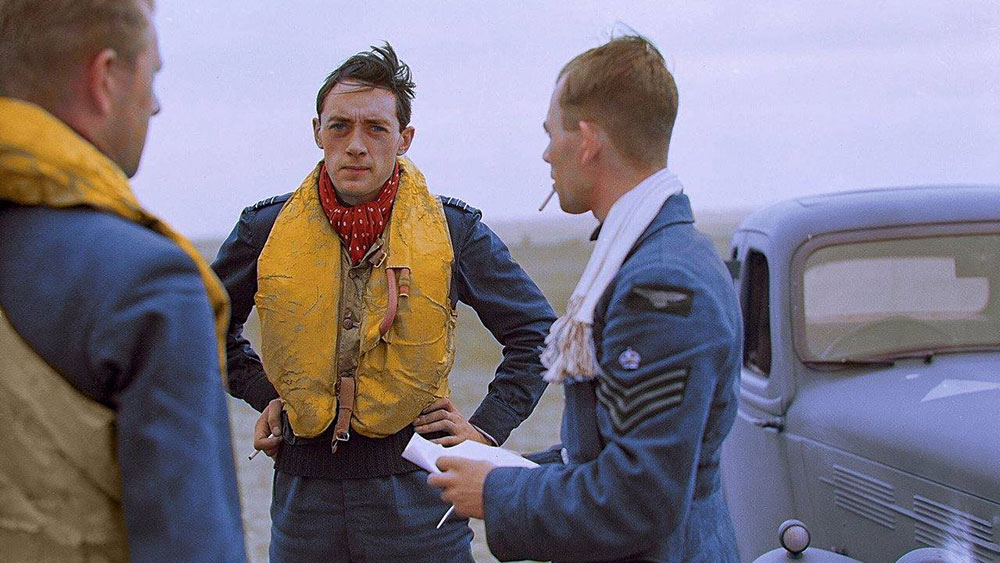
The photograph of an exhausted Brian Lane at RAF Fowlmere is one of the most reproduced images of an RAF fighter airfield in the Battle of Britain period. It shows three airmen on an exposed airfield, still in flying gear, in the blunt light of a working day. One man holds papers. Another smokes. The central figure of Brian Lane stands square to the camera, hands on hips, life jacket still on, scarf at the throat, face set in a way that reads as tired rather than theatrical.
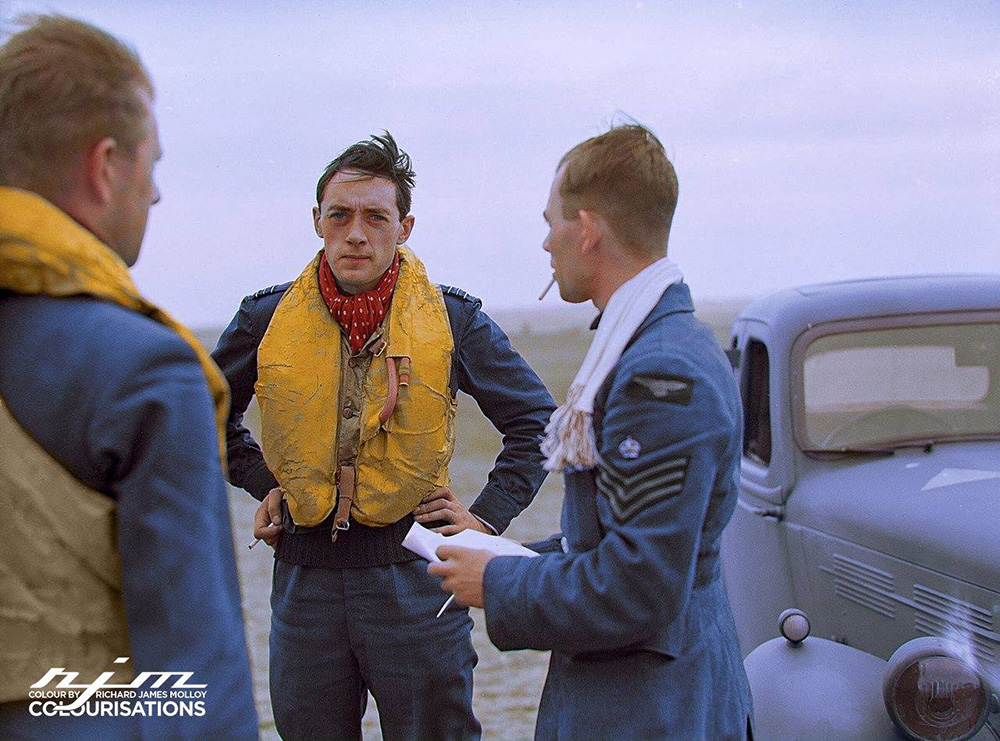
This image is often used in articles and exhibitions discussing Brian ‘Sandy’ Lane and No. 19 Squadron, because it captures the part of the story that films sometimes skip: the gap between sorties. The talk, the quick notes, the effort to turn a fight into something the next section can use.
It became iconic because it’s not a posed performance as many wartime photos are. There’s no victory pose and no staged grin. It looks like what it was: a debrief under strain, with the next scramble always possible.
If you want one picture that shows Brian Lane in the Battle of Britain, this is the one moment. Not the dogfight itself, but the constant return to work after it.
September 1940: the Duxford Wing and the arguments that didn’t matter at cockpit level
As September went on, 19 Squadron increasingly operated in larger formations associated with the Duxford Wing. Historians and enthusiasts still argue about the merits of that approach. At squadron level, the argument mattered far less than the practical problem of making it function assembling aircraft quickly, keeping formation, getting into the fight at the right time, and bringing pilots back alive.
Lane’s period in command sits right inside that hard month. Whatever your view of the “big wing” debates, he was doing the daily work of keeping a front-line Spitfire squadron effective.
After the battle: staff work, the Middle East, and a memoir published under a false name
Lane did not stay on constant operations. Like many successful squadron commanders, he was posted to staff duties. He served at group headquarters and later in the Middle East, where the RAF’s war looked very different: long distances, dust, heat, and a different tempo.
During this period, Lane wrote a fighter pilot memoir, published in 1942 under the pseudonym B. J. Ellan. The pseudonym was a product of wartime caution and censorship. The book matters because it preserves the texture of Fighter Command life from someone who had carried responsibility in the thick of it. It is one of the reasons Brian ‘Sandy’ Lane remains a figure people still search for, rather than a name that only appears on a memorial.
Return to operations: Squadron Leader Brian Lane and the final flight
In December 1942, Lane returned to operational command, taking charge of No. 167 Squadron. Four days later, on 13 December 1942, he failed to return from a low-level fighter operation over the Netherlands. His Spitfire was last seen pursuing enemy fighters near Schouwen.
He was posted missing, presumed killed. His body was never recovered. He is commemorated on the Air Forces Memorial at Runnymede, which bears the names of those with no known grave.
It is a stark ending, but also a common one for fighter pilots of his generation: a last sighting, then silence, then a name cut into stone.
Legacy: what people remember when the noise fades
Brian Lane’s RAF service is remembered in several overlapping ways.
He is remembered as a Battle of Britain squadron commander who took over No. 19 Squadron RAF at the most demanding point and kept it steady.
He is remembered as Brian ‘Sandy’ Lane DFC, a young man decorated early, trusted with responsibility, and spoken of with respect by those who flew beside him.
He is remembered as an author, because his account of Spitfire operations offered something rare: a record that feels like work, not propaganda.
And he is remembered through images like the photograph, which has become a quiet, honest shorthand for September 1940. Not glamour. Not slogans. Just three airmen, a few words over paper, and the weight of what comes next.