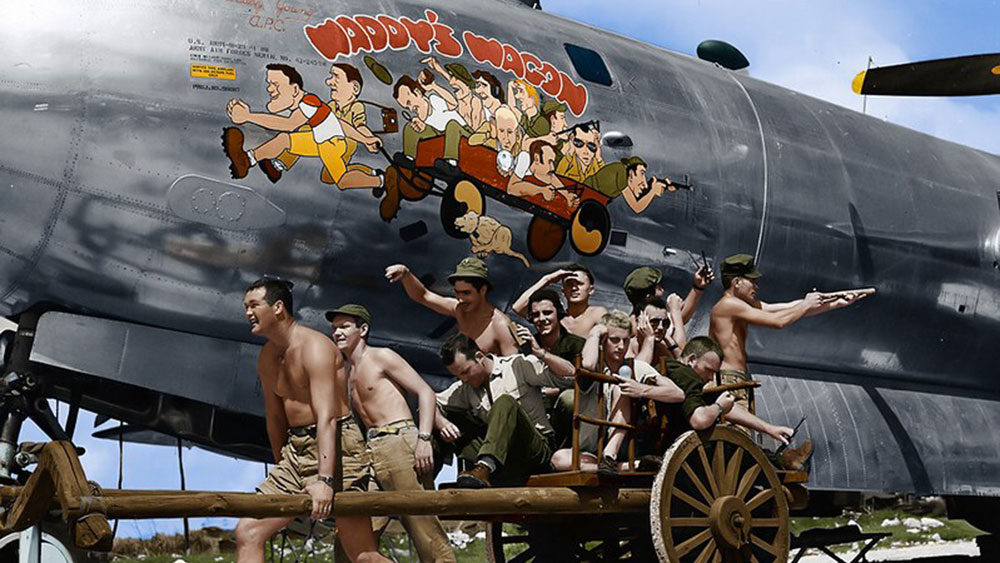
If you follow aviation accounts on social media, chances are, you might have seen this iconic photo before. It’s a photograph of the crew of the B-29 Superfortress, serial 42-2459, known from the nose-art as “Waddy’s Wagon”.
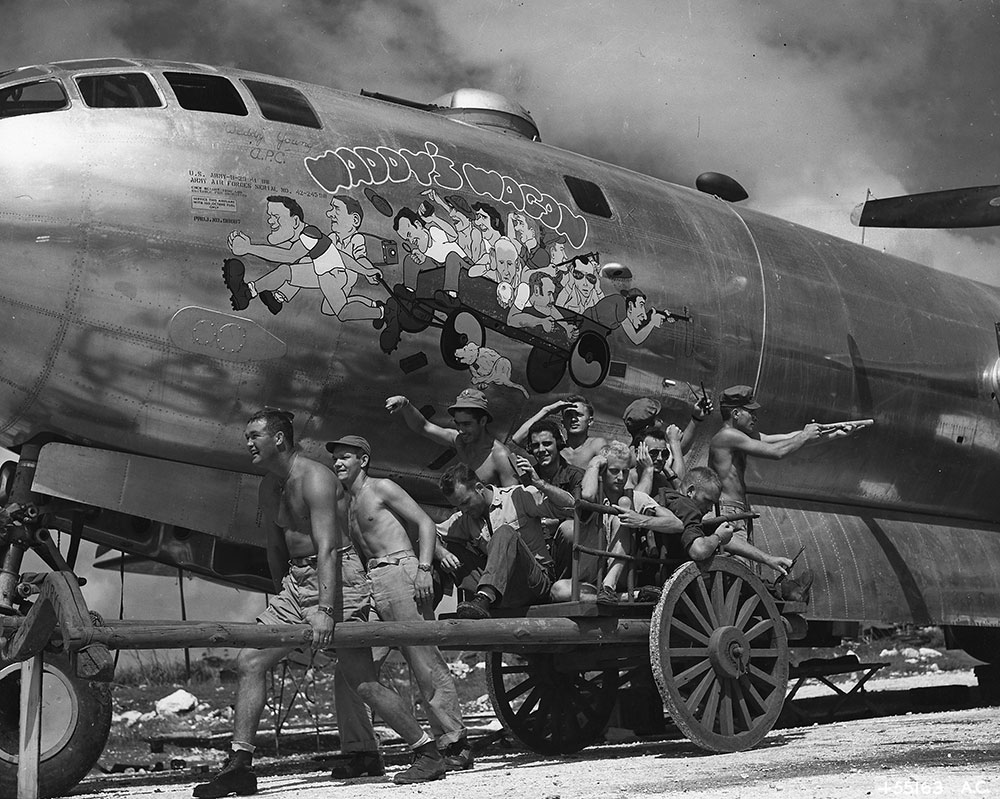
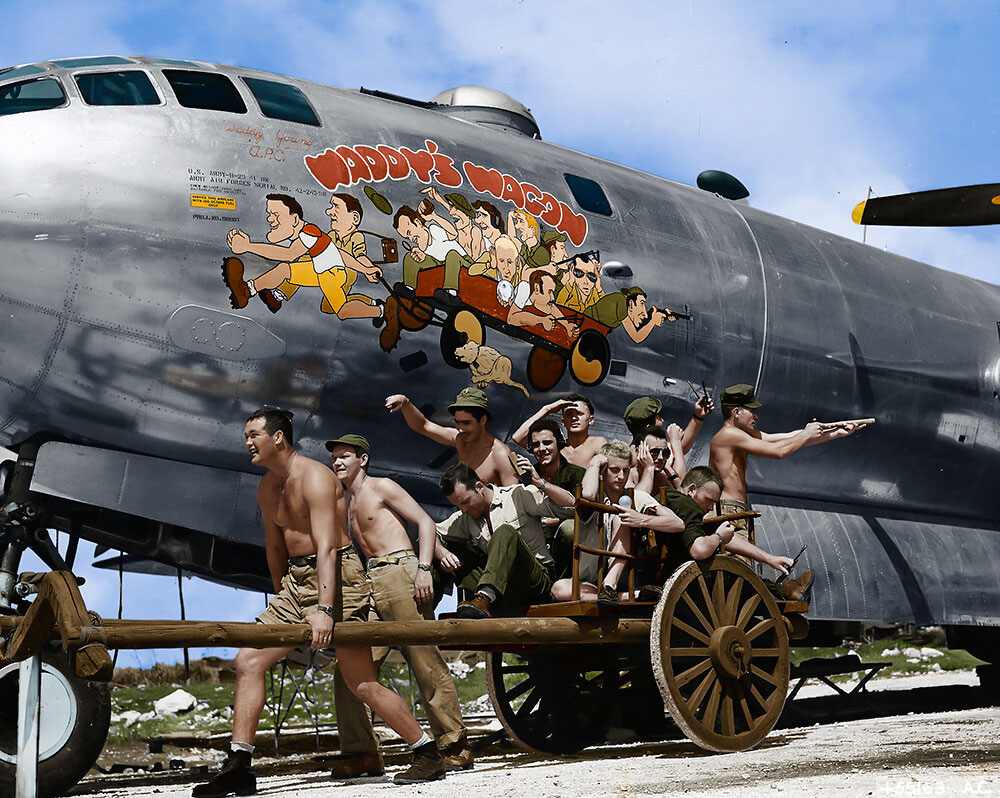
The photograph of Waddy’s Wagon draws people in because it’s doing two things at once. On the surface it’s pure crew room humour: a line of men stripped to the waist, straining at a wooden cart while others perch on the wagon and mug for the camera.
But the joke is anchored to something real and immediate. They are not hauling the aircraft. They are copying the cartoon painted as its nose art: the crew caricatured in a wagon being pulled along by their pilot, Capt. Walter R. “Waddy” Young, out in front like a draft horse.
It’s life imitating art.
The aircraft behind them was a Boeing-built B-29 Superfortress, serial 42-24598, serving with the 20th Air Force’s 73rd Bomb Wing, 497th Bomb Group, 869th Bomb Squadron, based at Isley Field on Saipan.
B-29 Waddy’s Wagon: operational history
Waddy’s Wagon was the fifth B-29 to take off on the initial Tokyo mission from Saipan to attack the Nakajima Aircraft Company factory on 24 November 1944. Waddy’s Wagon was the first to get back to Isley after the bombing raid.
That “initial Tokyo mission” matters because it marks the opening of the sustained B-29 offensive from the Marianas. Official USAAF histories describe the B-29 assault beginning on 24 November with a strike on Nakajima’s Musashino plant in Tokyo, chosen under directives that prioritised aircraft production. In other words, this was not a morale raid or a dress rehearsal. It was the start of a campaign intended to reach inside Japan’s war economy from bases newly seized and built up in the central Pacific. The early phase was supposed to be daylight, high-altitude precision bombing, but it quickly ran into the combination that haunted the campaign: distance, weather, and winds at altitude that scattered formations and made accuracy unreliable.
Musashino itself is a useful lens because it shows what “strategic” meant on the ground. A Musashino City history (drawing on USSBS material) describes the Nakajima Musashi Plant as a huge engine works employing more than 50,000 people at its peak, with output said to represent close to 30% of Japan’s national production of certain aircraft engines.
It was bombed nine times. The first four attacks, from 24 November 1944 through 9 January 1945, were grouped as the initial high-altitude raids, with bombs dropped from around 10,000 metres. Damage figures in that local account are modest for those early strikes, but the human cost is recorded alongside the percentages. Even when the plant was the aiming point, surrounding districts took bombs, and civilians were killed as well as factory staff.
The crew of Waddy’s Wagon
The crew of Waddy’s Wagon shown in the photo that day were: ‘Waddy’ Young (aircraft commander), Lt. Jack H. Vetters (pilot), Lt. John F. Ellis (bombardier), Lt. Paul R. Garrison (navigator), Sgt. George E. Avon (radio operator), Lt. Bernard S. Black (flight engineer), plus the enlisted technicians and gunners Kenneth Mansir, Lawrence Lee, Wilbur Chapman, Corbett Carnegie and Joseph Gatto.
Waddy Young is part of why this one aircraft has a name that still gets repeated. Before the war he was a University of Oklahoma star and the school’s first consensus All-American, later playing professionally in the NFL. Oklahoma’s own athletic department and the National Football Foundation both frame his story the same way: a sports career cut short by service, followed by the far less tidy reality of combat flying.
It’s worth keeping that in proportion. Plenty of B-29 aircraft commanders were former athletes, farmers, mechanics, teachers. Waddy Young’s fame didn’t make him a different type of officer, but it did make him easier to remember, which in turn keeps the crew together in the public mind rather than dissolving into “11 missing”. And that, really, is what the iconic nose art shown in the photo is doing too: fixing names and faces to a machine designed to be interchangeable.
The loss of Waddy’s Wagon
The end of Waddy’s Wagon sits inside the same Musashino story. On 9 January 1945 the 73rd Bomb Wing again went for the Nakajima works. Contemporary summaries agree on the basic points: the mission was costly, Japanese fighters attacked hard, and Waddy’s Wagon did not return.
The paperwork trail is real enough to cite: it appears in the USAAF Missing Air Crew Reports list as MACR 10908, with the location given in that index as “Chosi Point”, ten miles east. Beyond that, accounts diverge in detail. One commonly repeated version has the aircraft last seen descending near Chōshi and believed to have ditched at sea after being intercepted by enemy fighters; others fold it into the wider story of ramming attacks and damaged B-29s trying to nurse each other away from Tokyo.
What can be said without forcing certainty is simple, and bleak: by January 1945 the Marianas-based B-29 campaign was still in its hard learning period, the defences were not yet broken, and the crew in that famous Waddy’s Wagon photograph were lost on operations against the very target system that had made them news in November.
The crew of Waddy’s Wagon on the day it was lost were:
- Pilot: Captain Walter R. ‘Waddy’ Young, O-382584 (MIA / KIA) Ponca City, OK
- Co-Pilot: 2nd Lt. Robert M. Phillips, O-806901 (MIA / KIA) TN
- Navigator: 2nd Lt. Paul R. Garrison, Jr., O-698695 (MIA / KIA) Lancaster, PA
- Bombardier: 2nd Lt. John F. Ellis, O-685457 (MIA / KIA) Moberly, MO
- Engineer: 2nd Lt. Bernard S. Black, O-866285 (MIA / KIA) Woodhaven, NY
- CFC: SSgt Lawrence L. Lee, 37252164 (MIA / KIA) Max, ND
- Radio SSgt: George E. Avon, 32935478 (MIA / KIA) Syracuse, NY
- Left Gunner: Sgt Corbett L. Carnegie, 12214591 (MIA / KIA) Grindstone Island, NY
- Right Gunner: Sgt Wilbur J. Chapman, 38606304 (MIA / KIA) Panhandle, TX
- Tail Gunner: SSgt Joseph J. Gatto, 12024315 (MIA / KIA) Falconer, NY
- Radar: SSgt Kenneth N. Mansir, 11097819 (MIA / KIA) Randolph, ME