
On 15 December 1941, Sergeant Patrick Redmond Roach took off from RAF Heston in a Spitfire Mk I, serial X4923, on what was meant to be an ordinary training flight. The flight, and his life, ended in a field near Andover, Hampshire. The aircraft went in steeply and was destroyed. Roach, 19 years old.
If you want a neat story, this isn’t it. There was no combat report, no enemy claim, no triumphant return with holes in the wings. The surviving record, such as it is in public sources, is blunt: a training flight, a sudden descent into the ground.
And yet this small, quiet accident sits at the crossing point of two big wartime systems: the mass production and training pipeline that fed Fighter Command, and the equally large civic and workplace fundraising drives that tried to pay for it, or at least to feel they were paying for it. Roach died in a Spitfire that carried a retailer’s slogan on its side.
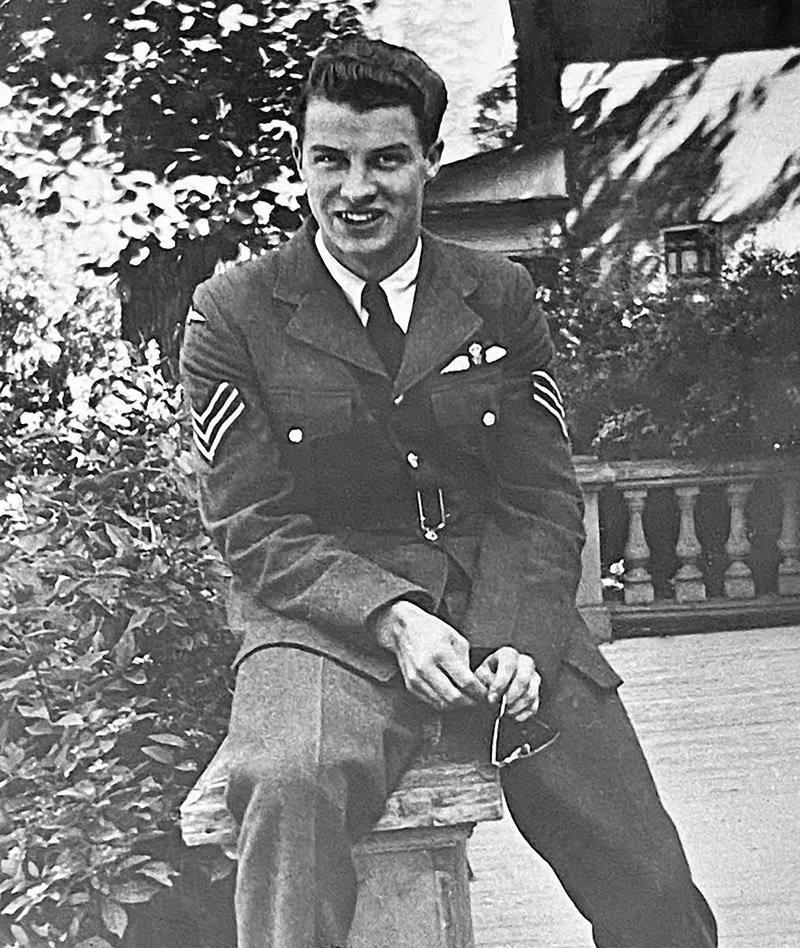
Sergeant Patrick Redmond Roach
He was born on 29 July 1922 in Montreal to parents Patrick Redmond Roach and Della Frances Roach (née Babcock), from Kirkland Lake, Ontario.
His enlistment date was 23 October 1940 in Ontario. At time of death, he was Sergeant Patrick Redmond Roach, service number R/74317, Royal Canadian Air Force, and attached to 61 Operational Training Unit (RAF).
Why a Canadian sergeant was learning to fly Spitfires at RAF Heston
By late 1941, the British and Commonwealth air forces were running on a production line mentality. Roach’s path fits a wider pattern shaped by the British Commonwealth Air Training Plan (BCATP). Canada’s Department of National Defence describes the BCATP agreement as a Commonwealth effort signed on 17 December 1939, built to train “battle-ready aircrew” at scale, using Canada’s space, safety from attack, and growing training infrastructure.
Veterans Affairs Canada’s BCATP fact sheet makes the point that training itself was hazardous. It records 856 trainees killed in crashes during the plan’s five years, a reminder that “not engaged in active fighting” did not mean safe.
On the RAF side, the training pipeline was deliberately staged. The RAF Museum’s own guide to pilot training during the Second World War describes initial training and ground school, then elementary flying on basic types, then service flying training on more powerful aircraft, then, after wings, further preparation at Operational Training Units to get pilots ready for front-line duties.
That final step is where Patrick Redmond Roach was. OTUs were not flying clubs. They were conversion factories, designed to take pilots who could already fly and teach them to handle the aircraft they would take into combat.
61 OTU, the unit named on Roach’s Canadian memorial entry, was based at RAF Heston in Middlesex in 1941. Summaries of the unit’s formation describe it as created at Heston on 9 June 1941 within Fighter Command’s training structure, to train fighter pilots using Spitfires and Masters.
A Miles Master was an advanced trainer, fast and unforgiving compared to elementary types, used to bridge the gap before a pilot climbed into a true single-seat fighter. That mix tells you what sort of flying Roach was doing: not formation sightseeing, but demanding conversion work where errors happened quickly and close to the ground.
The fatal flight on 15 December 1941
The basic facts can be stitched together from a few independent databases and casualty lists.
Aviation Safety Network records the aircraft as a Supermarine Spitfire Mk 1a, serial X4923, departing RAF Heston on a training flight, and notes that it suddenly went into the ground, destroying the aircraft and killing the pilot, Sgt Roach. Aviation Safety Network adds a location detail: “near Ribers Hill, north of Andover, Hants.”
RAFweb’s compiled casualty page for December 1941 includes Roach by name, gives his unit as 61 OTU, confirms the aircraft as Spitfire I X4923, and summarises the loss the same way: it went into the ground near Andover. It also confirms his burial in Hounslow Cemetery.
That is, effectively, what we know. The public sources available without pulling accident files from archives do not give a cause. They do not say weather, mechanical failure, loss of consciousness, disorientation, structural problem, or a training manoeuvre gone wrong.
It is still worth saying, carefully, what this sort of accident often looked like in OTU flying. A separate 61 OTU training crash described on Aircrew Remembered, from October 1941, reports a pilot seen levelling out and then going into a high-speed descent after aerobatics. That is a different man and a different aircraft, and it does not explain Roach’s death, but it does show the kind of flying being done around Heston in the same period, and how quickly a Spitfire could turn a mistake into a fatal impact.
Roach’s crash sits in that same hard category: training losses, often with few witnesses, and a single line in a list.
The Spitfire itself: X4923 and its earlier life
If the aircraft had been anonymous, it might have stayed anonymous. X4923 did not.
According to Woolworths Museum, X4923 carried the name “Nix over Six Secundus”. The same source states it was a Spitfire Mk I and that it was bought with cheques from Woolworth’s directors as part of a two-aircraft purchase, with the other aircraft, X4921, funded by staff contributions. It also says both aircraft joined No. 72 Squadron and made their maiden flights on 7 January 1941, and that X4923 later went to No. 411 (F) Squadron, RCAF, seeing active service from 22 June to 8 August 1941, before returning to training use.
Put those pieces together and you get a plausible arc for the airframe:
- Built and accepted early enough to fly in January 1941.
- Used first in a front-line squadron environment, then shifted into training work as newer marks and newer airframes took priority for operations.
- Back at an OTU by late 1941, still mechanically capable, but now doing the least glamorous work of all: teaching pilots to fly it.
That last phase mattered. In 1941 the Spitfire was no longer a novelty, but it was still a difficult aeroplane for a newly winged pilot. OTUs were where you learned how to fly it properly, and that learning had a cost.
Woolworth’s Spitfires and what “Nix over Six” meant
Woolworths in Britain had been known for the slogan “Nothing over sixpence”, commonly shortened into “Nix over Six”. It was a simple retail promise, and it travelled well as a piece of workplace identity.
In 1940, Woolworth staff wanted to channel that shared identity into war fundraising. Woolworths Museum describes a deputation asking the board to organise weekly staff donations from pay packets to buy a Spitfire for the RAF. The company directors agreed to match the staff contributions pound for pound. The result, it says, was that staff and stores raised £4,933, and directors added £5,067, making £10,000, enough to buy two Spitfires.
The two aircraft were named “Nix over Six Primus” and “Nix over Six Secundus”, a pseudo-Latin flourish on the slogan, and Woolworths Museum states the Ministry of Aircraft Production formally confirmed the names were applied on 11 December 1940.
Presentation aircraft and the habit of paying for fighters
The idea that a community or organisation could “buy” an aircraft was, in strict accounting terms, partly theatre. The state bought and allocated aircraft through wartime procurement, not through charity jars. But the fundraising was real money into the war economy, and the naming was real paint on real fuselages.
The Ministry of Aircraft Production scheme at the start of the Second World War was launched under Lord Beaverbrook. It states that targets were set at £5,000 for a fighter, and that some 2,000 aircraft, mostly Spitfires, were funded under the scheme, with donors’ chosen words painted on the fuselage in four-inch letters.
Why this mattered to people at the time
The fundraising drives gave people a way to touch the war. These funds were “tangible evidence” of support for the RAF when enemy aircraft were visible over southern counties and Hampshire airfields were busy.
That tangibility was often manufactured, sometimes literally. Plaques were issued. Names were painted on aircraft. Newspapers printed totals. People collected certificates and posed for photographs beside mock-ups and ceremonies.
None of this made the Spitfire itself less lethal to fly, or less likely to be lost in training. But it did create a sense of participation and ownership. It also created a trail that can still be followed, which is why X4923 is remembered not only as “Spitfire I X4923”, but as “Nix over Six Secundus”.
Roach’s death in the context of training losses
It is tempting, when writing about fighter pilots, to focus only on operational squadrons. Roach never reached one. That does not make his service marginal.
Both the BCATP fact sheet and the RAF Museum’s training guide stress the same point from different angles: training was long, staged, and dangerous, and the OTU phase came after wings, when a pilot was expected to move from “can fly” to “can fight”.
The casualty list that includes Roach also includes other training deaths on the same date, including another Spitfire crash and a Master crash, with burials in the same cemetery. Read as a group, it shows a war machine that kept turning every day, and a training system that produced pilots at speed, sometimes at cost.
Patrick Redmond Roach’s age, 19, is not unusual for the period. It is, however, still shocking when you stop treating “sergeant” as an adult word and remember that he had been eligible to vote for barely a year in Canada when he died.
He is buried in Heston and Isleworth (Hounslow) Cemetery, close to where he trained, at Plot D, Row E, Grave 4.
That proximity is one of the understated things about training deaths in Britain. Many of the men who died on OTUs never went overseas. Their war, in physical terms, is mapped onto English and Welsh airfields and nearby churchyards and municipal cemeteries.
X4923, the Woolworth Spitfire, does not survive either. If Woolworth staff and directors could have seen how it would end, they still might have raised the money. The point was never to guarantee an individual aircraft’s survival. The point was to keep enough aircraft and enough pilots moving through the system that the RAF could go on fighting.