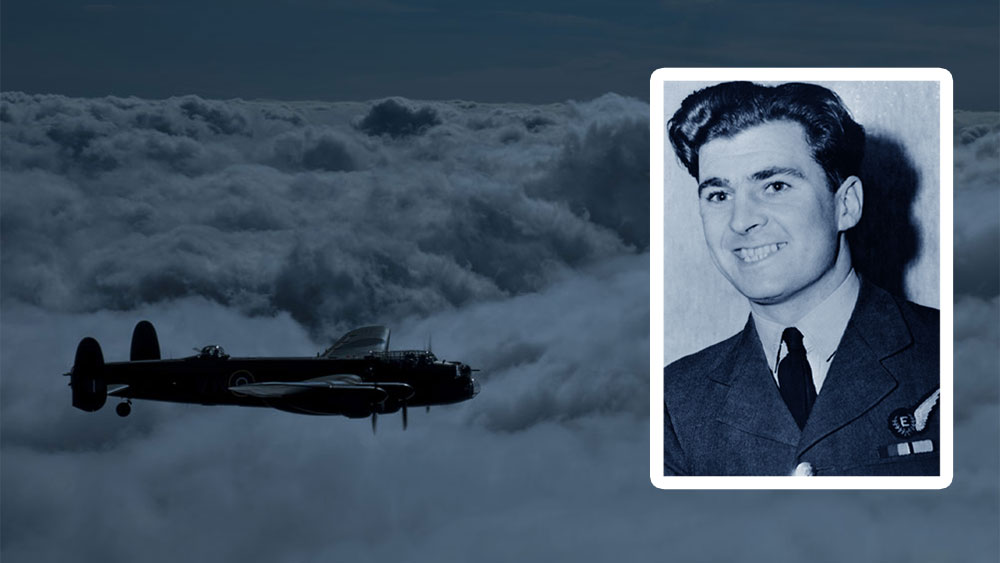
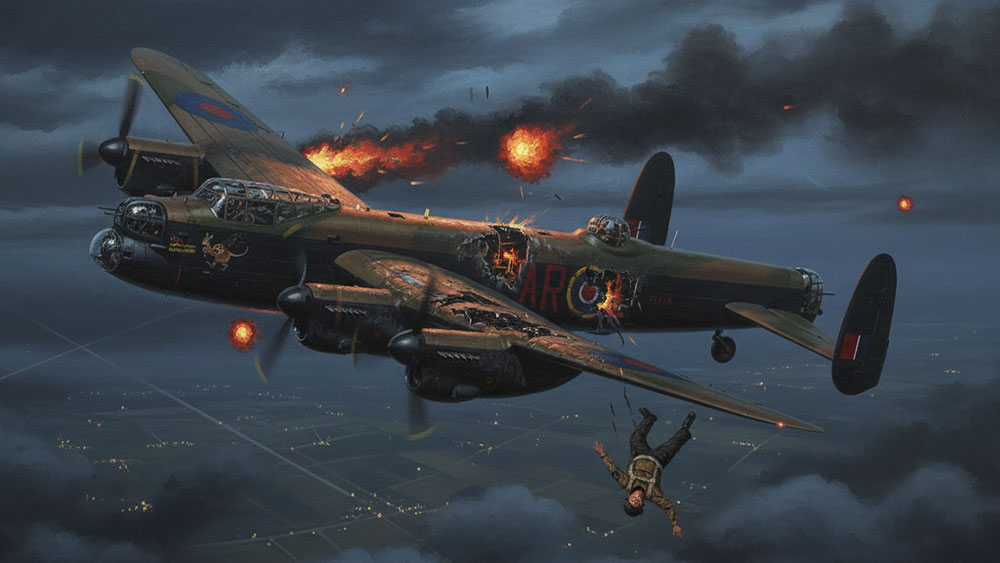
On a March night in 1944, a 21-year-old RAF tail gunner called Nicholas Alkemade made a decision that should have ended his life. Trapped in the blazing tail of a Lancaster bomber over Germany, his parachute destroyed by fire, he chose to step out into the dark at 18,000 feet (5,486 metres) rather than burn. He expected a few seconds of cold air and then oblivion. Instead, he woke up in the snow, under fir trees, with a sprained leg, then lit a cigarette to keep himself warm.
That single fall turned an otherwise ordinary airman, named Nicholas Alkemade, into one of the most improbable survival stories of the war.
The early life of Nicholas Alkemade
Like so many RAF airmen of WW2, Alkemade was an ordinary man… albeit before an extraordinary night. He was born Nicholas Stephen Alkemade on 10 December 1922, probably in North Walsham, Norfolk. Before the war he worked as a market gardener in Loughborough, a very down-to-earth trade for someone who would end up famous for falling through the sky.
As with many young men of his generation, he left civilian life for the RAF once war broke out. He trained as an air gunner and was posted to No. 115 Squadron, Bomber Command, then based at RAF Witchford near Ely. The squadron flew Avro Lancaster Mk II bombers on night raids against Germany.
Tail gunners had one of the least enviable positions in a bomber. Locked away in a tiny turret at the very back, they sat alone, scanning the darkness for enemy fighters. There was no room to wear a parachute in that cramped Perspex bubble; instead, the parachute hung inside the fuselage, a short but sometimes impossible crawl away. If fire or damage blocked that route, escape was close to impossible.
By March 1944 Alkemade had already flown over a dozen operations. Depending on the source, the Berlin trip would be either his 13th or 15th. In Bomber Command superstition, either number felt ominous.
The night Nicholas Alkemade fell from the sky without a parachute
On the evening of 24 March 1944, 115 Squadron joined a major RAF raid on Berlin. More than 800 aircraft took off, a force of Lancasters, Halifaxes and Mosquitoes heading for a city that had already endured months of night bombing.
Alkemade’s crew flew Lancaster DS664, a Mk II machine with the squadron code A4-K and the informal name Werewolf. They left Witchford just before 7 p.m. and made the long flight across the North Sea, over occupied Europe and on to the German capital. The outward leg went to plan: bombs dropped, course set for home.

The problems began on the return run. Strong winds pushed the bomber off its intended track. Instead of passing back over more lightly defended areas, Werewolf strayed towards the Ruhr – a region thick with heavy flak and prowling night-fighters.
East of Schmallenberg, close to midnight, the Lancaster was picked up by Oberleutnant Heinz Rökker, flying a Junkers Ju 88 night-fighter of Nachtjagdgeschwader 2. He attacked from below, the classic night-fighter approach, raking the bomber with cannon fire. The Lancaster’s fuel and oxygen systems were hit; fire raced along the fuselage and into the tail.
In the rear turret, Nicholas Alkemade’s night changed in an instant from routine watchfulness to raw survival.
Fire in the tail
Accounts drawn from his later interviews and writings give the bare bones of what happened next.
Flames reached the tail, licking around the turret framing. His oxygen mask began to melt against his face. Perspex panels blistered and cracked. He tried to rotate the turret and clamber forward into the fuselage, the only path to his parachute, but the controls were damaged and the bomber was now in a tightening spiral.
He did reach the main fuselage briefly. There, through thick smoke and intense heat, he found his parachute – on the floor, burning. In later years he described staring at it for a moment as it shrank in the flames, feeling not so much terror as a deep wrenching in his stomach
He now faced a choice that hardly deserves the word. He could stay in the aircraft and die by fire or go out into the night without a parachute and die on impact.
He chose the air.
Nicholas Alkemade falls 18,000 feet in the dark
He clipped off what remained of the useless parachute harness, made his way back to the turret opening and pushed himself out into the slipstream.
One moment he was in a furnace of noise, light and heat; the next he was in cold, silent darkness. Above him, Werewolf was a burning cross in the sky. It exploded sometime after he left, breaking apart over the German countryside. Of the seven-man crew, four would die in the crash. Two others, their parachutes functioning, would become prisoners of war.
Free of the aircraft, Alkemade tumbled, then stabilised into a fall. He later estimated that he fell for perhaps thirty seconds or more. In a normal terminal-velocity fall from that height a man would reach around 120 mph. There was nothing to do; no ripcord to pull, no canopy to watch. He could see the stars above and a dark mass below which, he realised, must be forest. At some point he lost consciousness.
“I had the choice of staying with the aircraft or jumping out. If I stayed, I would be burned to death – my clothes were already well alight and my face and hands burnt, though at the time I scarcely noticed the pain owing to my high state of excitement… I decided to jump and end it all as quick and clean as I could.”
By every reasonable law of physics and probability, that should have been the end of his story.
Trees, snow – and a cigarette
Three hours later, Nicholas Alkemade woke up.
He found himself lying on his back in deep snow, surrounded by young fir trees. When he looked up, he saw a neat gap in the canopy directly above him, a circular hole through which the stars still shone. He traced his fall in his mind: through the top branches, down through bending saplings, into snow perhaps a foot and a half deep.
He tested his limbs. Everything moved. No broken bones. He had burns from the aircraft fire, superficial cuts, and a twisted knee. That was all.
His flying boots had been torn off in the fall. Sitting there in his socks, he did something very RAF: he took out his cigarette case, lit a cigarette and considered his position.
Unable to walk far on the injured leg and barefoot in the snow, he unbuckled the empty parachute harness and blew his distress whistle. Local civilians arrived, then German authorities, and he was carried to a nearby infirmary and on to hospital at Meschede.
The nurses there treated his injuries, but the Gestapo wanted answers.
The Gestapo investigation
The story that Nicholas Alkemade told his interrogators sounded absurd on its face: an RAF gunner had fallen three and a half miles without a parachute and survived with a sprain. The Gestapo officers’ first reaction was straightforward disbelief. They suspected that he had hidden his parachute, perhaps to support some espionage cover story.
Alkemade insisted they check the wreck of the Lancaster. He told them where his parachute had been stowed and how they would find the webbing still locked in the closed position, the ripcord handle and cable undisturbed.
A party went out to the crash site. There they found the remains of the aircraft and, as he had described, a charred parachute pack still in its rack, the metal ripcord handle and cable untouched. The harness that he had worn out of the aircraft was also examined; the securing straps were still in their stowed configuration, proving the parachute had never deployed.
The Gestapo had little choice but to accept that, against all expectation, he was telling the truth.
In due course, the German authorities issued him with a certificate, signed by fellow prisoners and a senior British officer, recording that it had been “investigated and corroborated” that Flight Sergeant Nicholas Alkemade had made a descent from 18,000 feet without a parachute and landed safely, his parachute having been destroyed by fire in the aircraft.
Among Allied prisoners he became a minor celebrity. At Dulag Luft, the transit and interrogation centre for captured aircrew, a German officer reportedly introduced him to other POWs with something approaching professional admiration: here, gentlemen, was the man who had fallen out of a Lancaster and walked away.
From there he was sent to Stalag Luft III, the same camp later associated with the Great Escape. He survived the winter “death marches” of 1945, when POWs were forced to move west in brutal conditions ahead of the advancing Soviet forces.
In May 1945 he was repatriated to Britain. The story of his fall followed him home.
After the war: a quiet life
For all the sensational headlines – and they wrote themselves – Nicholas Alkemade did not turn himself into a professional survivor. After demobilisation he went back into ordinary work, this time in the chemical industry.

He married, raised a family, and for decades his story was something told mainly inside Bomber Command circles and among former POWs. Late in life he appeared on a couple of British television programmes about strange feats and survival stories, talking calmly and without drama about the night he stepped out of a burning bomber and expected to die.
He died in 1987 in Cornwall, aged 64. At RAF Witchford, where 115 Squadron had once been based, his story is recorded in the museum display, along with his whistle and other small objects from his service.
In 2020, 115 Squadron – now a training unit at RAF Wittering – voted to name one of its buildings after him. For an air force that had lost over 55,000 men in Bomber Command alone, it was a small but fitting nod to a man whose luck, or physics, or some combination of both, had briefly defied that toll.
Chance, statistics, and the ones who did not walk away
From a dramatic point of view, Alkemade’s story has everything: an arresting headline, a clear narrative arc, a shocking central event and an almost blackly comic coda – the cigarette in the snow, the baffled Gestapo, the official German certificate.
But behind the sensational story sit some uncomfortable truths.
Bomber Command’s casualty rates were dreadful. Out of around 125,000 aircrew who served, more than 55,000 were killed, thousands more wounded and nearly 10,000 taken prisoner. For most crews, a flaming Lancaster at 18,000 feet meant death for everyone on board. Stories like Nicholas Alkemade’s stand out precisely because they are so rare.
How did Nicholas Alkemade survive?
So, just how did Nicholas Alkemade survive falling without a parachute? Contemporary discussions usually point to three factors: the way the young fir trees bent and snapped under him, lengthening the deceleration; the depth of the snow; and the possibility that the broken remains of his turret and other wreckage fell with him and absorbed some of the energy. Others have suggested that his unconsciousness might have left his body looser on impact, although that strays into speculation.
Whatever the mechanics, the odds were still terrible. You could jump a thousand times under the same conditions and expect catastrophe almost every time. What happened to ensure that Nicholas Alkemade survived is the type of event that statisticians class as an outlier – the kind of thing that can occur, but so rarely that it becomes a story precisely because it did.
It is tempting to wrap such events in meaning: fate, providence, “someone up there was looking out for him”. Nicholas Alkemade himself tended to talk about it without grand theory. His number, he suggested, had not come up that night. His crewmates’ numbers had.
Beneath the headline you clicked into to read about the gunner who fell from the sky is an ordinary chap from Norfolk who went back to work in a factory and got on with his life. He did something unimaginably brave in the moment – stepping into the night with no parachute – but didn’t make a fuss about it afterwards.
Most aircrew stories ended in a way no one could spin. An aircraft missing, a telegram to a family, a name on a panel of stone. Alkemade’s survival does not balance those losses. It does, however, give a human face to the statistics and a reminder that, inside those aircraft, sat gardeners, clerks, apprentices, lads barely out of school.
One of them, for reasons that will always feel slightly unreal, fell three and a half miles without a parachute and lived to tell the tale.
Did You Know? Nicholas Alkemade wasn’t the only Allied pilot who fell without a parachute and survived. USAAF ball turret Gunner Alan Magee also did the same and lived to tell the tale.
RIP Nicholas Alkemade
Nicholas Alkemade died on 22 June 1987 in Liskeard, Cornwall. He was aged 64. I believe that his cause of death was natural.