
In the early hours of 4 March 1945, with the war in Europe visibly running out of road, a Luftwaffe night fighter came down on a Yorkshire farmhouse and killed civilians in their own beds. A lot of late-war air activity over Britain blurs into logistics, training flights, aircraft lost to weather. This one does not. It sits on a timestamp and a place, and it carries a grim little superlative with it.
On the memorial at Dunnington Lodge Farm the wording is careful, almost judicial: “THIS J.U.88 IS BELIEVED TO BE THE LAST LUFTWAFFE AIRCRAFT LOST OVER THE U.K. ON A NIGHT SORTIE.”
That caveat matters. The story has been retold for decades, sometimes with the edges knocked off, sometimes with details swapped in from other incidents. Even the aircraft’s identity has been argued over. But the core is solid enough to walk around. A Junkers Ju 88 night fighter, low over RAF Elvington, struck trees and ploughed into Dunnington Lodge at 01:51.
If this Ju 88 was the last plane to be shot down over Britain, it comes 1,954 days after the first, which was the Humbie Heinkel in Scotland on 28 October 1939.
The last German aircraft to be shot down and lost over UK soil
The night the Luftwaffe came back
The crash belongs to Operation Gisela, the Luftwaffe’s late attempt to turn the RAF’s own routine against it. Instead of meeting Bomber Command over Germany, German night fighters slipped in behind the returning stream and hunted around the airfields.
One contemporary squadron account calls it “large scale German intruder operations… over eastern England”, with Ju 88s crossing “at wave top level”. In the same account, a pilot describes spotting German night-fighter beacons on the Dutch coast and reacting immediately: “I dropped to sea level… and we came back just over the tops of the waves.”
By March 1945 the RAF had habits. So did its airfields: landing lights, funnels, the whole reassuring theatre of home. Gisela aimed straight at that softness. Research compiled by the Yorkshire Air Museum describes Ju 88 intruders coming in low over the North Sea, then climbing to meet the returning bombers close to their bases.
Dreher’s Ju 88 and the last minutes
The aircraft most often linked to the “last on UK soil” claim is a Ju 88G-6 coded D5+AX, flown by Hauptmann Johann Dreher, operating with Nachtjagdgeschwader 3.
Accounts place Dreher over RAF Lissett first and connect him with the loss of a 158 Squadron Halifax, PN437 (code MP-X), before he turned towards RAF Elvington, where French-crewed Halifaxes were coming home.
Halifax PN437 did not make it. Local crash records describe the aircraft being attacked in the Driffield area and falling near Sledmere Grange around 00:30, with the crew killed.
At Elvington, one narrative describes Capitaine Paul Notelle in a 346 “Guyenne” Squadron Halifax being warned by the tower and diverted north, avoiding Dreher’s immediate attack.
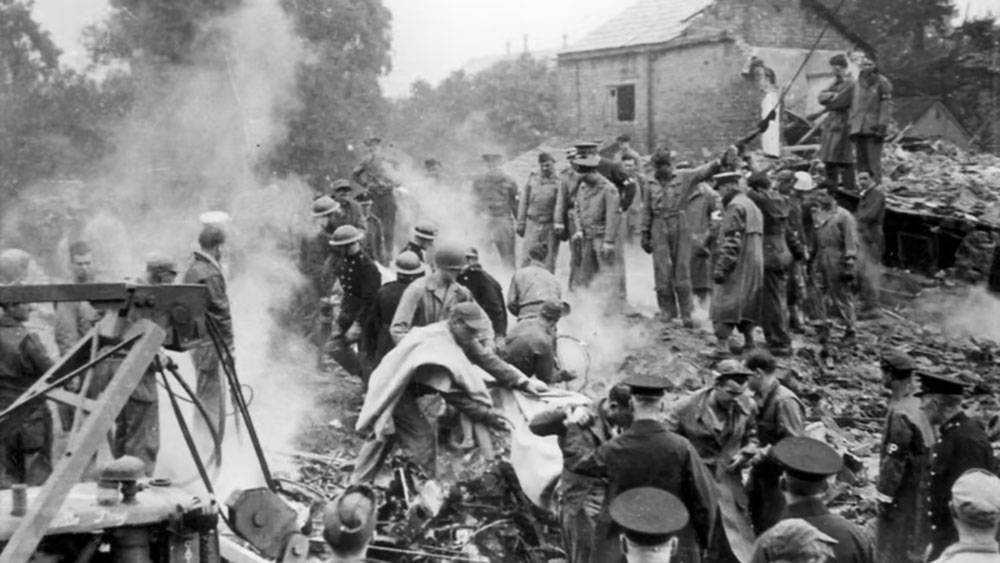
Then came the low pass that ended the Ju 88. The museum account is blunt: Dreher “clipped a tree and crashed through one section of the building at 01:51am.” Other summaries agree on the essentials: a tree strike during an attack run, a crash into a farmhouse, four crew dead and three people on the ground killed.
Those civilians were the Moll family. Richard Moll (67) died the following day; Ellen Moll (61) and Violet Moll (28) died on 4 March after being taken to hospital.
If you want the smallest possible “what happened”, the York historic record does it in one line: the plane hit a tree and crashed into the farmhouse, killing three members of the family inside.
“Shot down” or simply lost?
People often describe this German aircraft as “shot down”, because it was destroyed during a combat intrusion and because the end result looks, on the ground, like a defeat. But the best-supported accounts lean on physical causes: low-level manoeuvring, trees, impact.
Some retellings introduce confusion over vehicle headlights and the chaos of night, and you’ll sometimes see anti-aircraft fire mentioned in secondary sources. The memorial text itself, though, does not claim a clean “kill” by gunfire. It simply says the aircraft was “lost”.
The most accurate way to put it is this: the Ju 88 was brought down in the course of Gisela, at very low level, while attacking RAF Elvington, and it did not leave British soil again.
The awkward detail people miss: the paperwork is messy
Even if you accept the Dunnington crash as the last Luftwaffe plane to be shot down and lost on British soil, the aircraft’s exact serial details and even aspects of the unit/identity get tangled in the record.
One local research page lays it out plainly: “The full facts of exactly what happened to this aircraft remain somewhat unclear… there are conflicting accounts.” It also notes that D5+AX is the identity given in a National Archives file reference (AIR40/2421), while other serial numbers appear elsewhere.
You can see the knock-on effect in public memorial transcriptions and local summaries too, where codes and Werknummer details don’t always match from one version to the next. That doesn’t make the event doubtful. It shows how late-war losses, hurried intelligence, and decades of copying can drift.
A memorial that points in two directions
The cross at Dunnington Lodge is unusual because it is not only about combatants. It names the crew, and it names the civilians. The local historic record frames the crash as a memorial to “the futility of war” and records the dedication date as 19 June 1993.
The longer inscription, preserved in a national memorial archive, records something else that can be hard to picture in a story like this: former enemies meeting on the same patch of ground. It notes that a wreath was laid by a Luftwaffe night fighter association representative and by Arthur Tait of the Doncaster Air Gunners Association, “bringing together old wartime enemies in friendship”.
That closing gesture doesn’t redeem anything. It does underline why this crash still catches attention. The war was almost done. The targets were no longer cities, or even airfields in any strategic sense, but the soft, lit-up routines of men coming home.
And the last aircraft to fall in Britain did not land in a field.
It came through a wall.