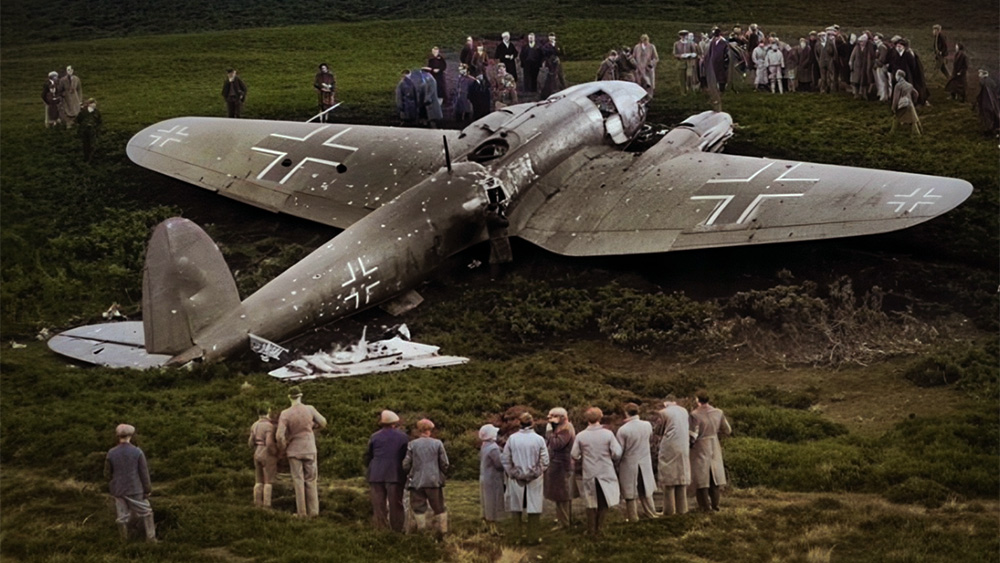
On 28 October 1939, a German Heinkel He 111 bomber came down in the Lammermuir country near the East Lothian village of Humbie. It was not a flaming wreck or a neat ditching at sea. It landed on land, damaged but recognisable, and it landed early enough in the war that people were still learning what the war would look like at home. The aircraft quickly picked up a nickname, “the Humbie Heinkel”, and the photographs of crowds around it did the rest.
Officially, it is often described as the first German aircraft to come down on British soil during the Second World War, brought down after interception by Spitfires from 602 (City of Glasgow) and 603 (City of Edinburgh) Squadrons.
That phrasing matters, because the skies over the Forth had already seen combat. Twelve days earlier, on 16 October, Luftwaffe aircraft attacked in the Firth of Forth area and RAF auxiliary squadrons fought them, with aircraft falling into the sea. That earlier action, and the Humbie Heinkel crash, have a habit of blurring together in retellings. Even in formal summaries, you can see how easily it happens.
So, the Humbie Heinkel sits in an odd place in the early-war record. It is a clean “first” if you mean “first enemy aircraft to be brought down onto land in Britain”. It is less clean if you mean “first enemy aircraft shot down in Britain” full stop. The historical interest is not just in the technicality. It is in what the event shows about how the air war over Britain started: in fragments, over water and farmland, with auxiliary squadrons doing work that very quickly stopped feeling auxiliary.
Why the Forth drew bombers in the first place
Look at a map of Britain’s east coast and the Firth of Forth stands out as a hard, useful inlet pointing into industrial Scotland. It also mattered for the Royal Navy. In the first months of the war, German reconnaissance and anti-shipping sorties along Britain’s coasts were part of a wider effort to find targets and test defences.
On the British side, the RAF was trying to build a workable system from radar plots, Observer Corps reports, and fighters that could climb and intercept in time. Scotland’s auxiliary fighter squadrons became central to that. In accounts of the 16 October action, auxiliary Spitfire pilots are described as opening the air war over Britain and shooting down aircraft that fell into the sea off East Lothian, prompting Dowding’s message of congratulations.
The Humbie Heinkel incident is best understood as part of that same pattern: German sorties probing shipping and infrastructure, British fighter units sharpening the intercept drill, and the first months of the war being far less quiet than the “Phoney War” label suggests from a London perspective.

The aircraft and its job
The Heinkel He 111 was one of the Luftwaffe’s main medium bombers. By late 1939 it was a familiar shape in German bomber units, and a dangerous one. The Humbie aircraft is commonly identified as a Heinkel He 111H-2, coded 1H+JA, attached to Stab./KG 26 (the command flight of the wing).
What was it doing over East Lothian? Sources agree on the broad point: an armed reconnaissance sortie that took it into Scottish coastal waters. Some accounts describe a long-range mission covering the Firth of Clyde and the Firth of Forth before the bomber was engaged and forced down near Edinburgh in the Lammermuir Hills.
That basic outline matches the way the story is told in Scottish education material and squadron histories: an enemy aircraft over East Lothian, a scramble and intercept, then a forced landing near Humbie.
The fight on 28 October 1939
The fight itself is usually told in a few sharp steps.
First, the RAF spotted and engaged the Heinkel. In one widely used Scottish summary, the main credit goes to 25-year-old Flight Lieutenant Archie McKellar of 602 Squadron, said to have seriously damaged the bomber, with Spitfires from 603 Squadron also joining the combat.
Second, the bomber lost its ability to keep going. The same account says two of the German crew were killed during the battle, while the pilot was wounded.
Third, it came down near Humbie. Aviation accident records give the location as Newton Farm, Humbie, with two killed and two injured among a crew of four.
Fourth, the survivors surrendered. The wounded pilot and the navigator are said to have given themselves up to a local policeman who reached the scene first, becoming prisoners of war.
Those points are the core that can be repeated without too much risk. Beyond that, details start to shift depending on source, and it is worth saying so plainly.
One example is “who got the kill”. Post-war and popular accounts often give the victory to McKellar. At the same time, some summaries emphasise that 602 and 603 were both involved, and that attribution has been debated.
Another example is the exact chain of damage. Some later narratives describe anti-aircraft fire hitting the Heinkel over the Forth and then Spitfires locating it lower down, after which repeated attacks knocked out both engines and killed the two air gunners. That sequence is plausible, and it may well be right, but without the original combat reports in front of you it is sensible to treat it as a stitched narrative rather than a verbatim reconstruction.
What does not really move is the result: a German bomber forced down on land in East Lothian in October 1939, leaving two dead crewmen and two prisoners, and giving Britain an early, very public piece of evidence that the war was not going to stay “over there”.
Who was on board the Humbie Heinkel
Several sources list the crew and their fates with a fair level of consistency:
- Unteroffizier Kurt Lehmkuhl (pilot), captured wounded
- Leutnant Rolf Niehoff (observer or navigator), captured
- Gefreiter Bruno Reimann (radio operator/gunner), killed
- Unteroffizier Gottlieb Kowalke (flight engineer/gunner), killed
Those names matter because they stop the incident becoming a neat little propaganda vignette. Two men died in a field in East Lothian less than two months into the war. Two others survived to spend the war as prisoners. And on the British side, the pilots involved were not mythical Battle of Britain figures yet. They were auxiliary squadron men learning, fast, what it meant to intercept for real.
Why “first German aircraft shot down on British soil” stuck
The phrase has staying power because it points to something visible. The two aircraft lost on 16 October went into the sea. The Humbie Heinkel sat in the open on land, photographable, visitable, and legible to anyone who walked up the hill.

It also arrived at the right moment for a particular kind of wartime story. In late 1939, Britain was still adjusting to the idea of modern air war. The country had prepared for bombing and invasion in the abstract, but there is a big psychological difference between preparation and a German aircraft lying on Scottish ground with crowds around it.
Modern summaries by the RAF and Scottish institutions still use the “first German aircraft to come down on British soil” line, which helps keep the wording standard.
At the same time, centenary material on Scotland’s auxiliary air force makes an important, slightly deflating point: the October events are often confused or rolled into one by public perception and folklore even though they were separate incidents.
If you want a clean way to understand what the first Luftwaffe / German aircraft was to be shot down over the UK, it is probably this:
- 16 October 1939: early air fighting over the Forth, with German aircraft shot down into the sea off the Scottish coast, widely treated as the first Luftwaffe raid on Britain.
- 28 October 1939: the Humbie Heinkel, the first German aircraft of the war to be brought down onto British land.
What happened to the wreck, and why it became famous
If you only know the Humbie Heinkel story through a single caption, it is easy to miss how much of its fame came from what happened after it hit the ground.
One Scottish summary is explicit about the nickname, “later dubbed ‘the Humbie Heinkel’”, and the widely circulated images of crowds around the downed bomber support that it became a local spectacle.
Squadron material also hints at the longer tail. One association notes that the Heinkel was able to land substantially complete and adds that parts of the aircraft can still be seen in a squadron museum collection.
That matters for two reasons.
First, intelligence. A fairly intact enemy aircraft is a gift to the people trying to learn how it is built, how it is equipped, and what it might tell you about German tactics. Some later accounts attach specific intelligence lessons to the Humbie Heinkel aircraft, although those details should be treated carefully unless backed by primary documentation.
Second, memory. A wreck you can stand next to becomes a marker. It turns up in collections and local records, and it drifts into family stories. Modern reporting on Scottish wartime archives includes at least one account of a child witness keeping a small souvenir. University archive catalogues also note an eyewitness diary reference to a “Humbie Heinkel” in late 1939.
That is what “firsts” do when they are visible. They become souvenirs, and then they become sources.
Archie McKellar and the shape of recognition
The Humbie Heinkel story is often told as part of Archie McKellar’s reputation. In one widely repeated Scottish narrative, he is the central figure on 28 October, with 603 Squadron also involved.
There is a temptation to turn that into a tidy moral about fame and forgetfulness. It is better not to. Recognition in wartime and afterwards is bound up with paperwork, eligibility rules, unit postings, and the hard fact that some men become symbols while others do not. What the records comfortably allow you to say is simpler: McKellar is closely associated with the Humbie Heinkel in squadron and Scottish educational narratives, and the incident is still used to illustrate how quickly Scottish auxiliary units were involved in the shooting war.
What we cannot say with full confidence
Even with a well-known incident like this, a few points stay slightly slippery unless you go back to original combat reports and operational record books:
- The precise division of credit between pilots and squadrons. Multiple sources acknowledge debate.
- The exact sequence of damage (how much came from anti-aircraft fire versus fighter attack). Some accounts offer a full narrative, but that is not the same as a primary report.
- The exact spot name used for the crash site in every record (Newton Farm is one, and other place descriptions circulate in secondary retellings).
None of those uncertainties changes the core history. They just change the tone. The Humbie Heinkel is not a legend that needs polishing. It is a well-attested early-war incident with a famous photograph trail and a slightly fiddly “first” attached to it.
And if you are you wondering what the last Luftwaffe aircraft shot down over UK soil was, it came 1,954 days after the Humbie Heinkel, and was a Ju 88 in Yorkshire in March 1945.