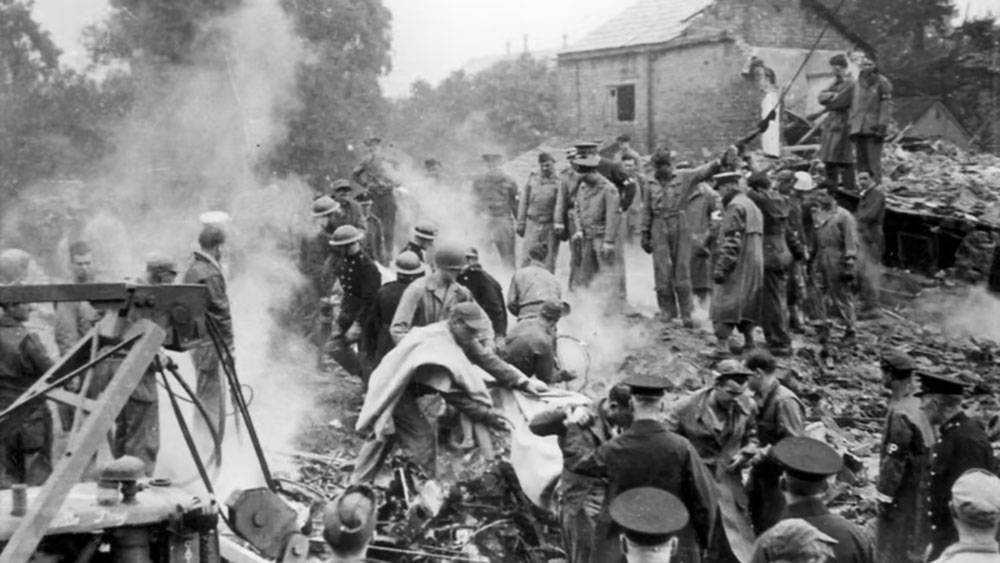

Hampden L4072 of No. 49 Squadron left RAF Scampton on 21 December 1939 as part of a combined maritime sweep intended to find the German “pocket battleship” Deutschland. The ship was not found. On the return, with weather closing in and fuel margins gone, Hampden L4072 diverted to RAF Acklington and crashed into the Church of Christ at North Broomhill in Northumberland during an attempted emergency landing. Two of the four crew were killed.
That short summary is the easy part. The real story sits in the gaps between “routine” and “accident”, and it tells you a lot about Bomber Command’s winter of 1939: long-range patrols at the edge of performance, incomplete information, and a system still learning how to keep its own aircraft alive.
Why Hampden L4072 was up there at all
In December 1939, Bomber Command was doing a great deal of maritime work. It was partly politics and partly necessity: early-war limits on bombing, and a very immediate fear of German surface raiders and mine warfare. Hampdens, fast by the standards of the mid-1930s, were used on armed reconnaissance and shipping searches from the start of the war.
The “Hampden Patrol” was one expression of this. No. 5 Group’s Lincolnshire squadrons, including 49 Squadron at RAF Scampton and 44 Squadron at RAF Waddington, were among those tasked to provide aircraft for these northern maritime sorties while continuing other commitments.
The order: sink ‘Deutschland’ off Norway
The 49 Squadron Association’s summary (drawing on the squadron’s Operations Record Book narrative) sets the scene with unusual clarity. At 21.00 on 20 December the squadron received instructions to bomb the Deutschland ship, reported near the Norwegian coast, and then to return to the Scottish base of RAF Leuchars. Next morning, 12 Hampdens of 49 Squadron took off from Scampton, met 12 Hampdens of 44 Squadron over Lincoln, and the combined formation headed out over the North Sea, passing over Skegness. On reaching the Norwegian coast, they turned north and spread out line abreast to hunt for the ship. The search came to nothing, and at the limit of range the aircraft turned back for Scotland.
That last phrase, “the limit of their range”, matters. It is the quiet reason why a diversion to a fighter station in Northumberland could become a life-or-death decision.
The return: sleet, separation, and fighters in the wrong places
The same account describes the return flight being made in sleet and rain showers, with visibility reduced. The two squadrons became separated. The Scampton element made landfall in Northumberland, was intercepted but correctly recognised as friendly, and most aircraft landed at RAF Acklington by 15.47.
Meanwhile, the Waddington element crossed the coast farther north than intended, near the Firth of Forth. That was the seed of the day’s better-known incident when Spitfires flying from RAF Drem (602 Squadron) shot down two 44 Squadron Hampdens after misidentification.
Hampden L4072 was not one of the aircraft attacked over the Forth. It was one of the Hampdens that reached Northumberland and tried to get down.
RAF Acklington in 1939: why it was there, and why crews went to it
RAF Acklington had reopened in 1938, initially for training activity, and became a designated fighter station at the beginning of the war.
For a Hampden crew arriving back from Norway in worsening weather, that mattered. Acklington was a known, guarded field on the coast with Fighter Command eyes on it. It was also close enough to be reachable when the planned Scottish destination was slipping out of reach.
The crash of Hampden L4072: “short of fuel” becomes a chapel roof
On approach to RAF Acklington, 49 Squadron’s account is blunt: one aircraft was “short of fuel” and “having problems”. Piloted by Sgt Edward Marshall, it crashed into the Church of Christ at North Broomhill on the edge of the aerodrome. Marshall was seriously injured, P/O James Melville Dundas Irvine was injured, and two members of the crew were killed.

Accident compendiums broadly align on the core facts: fuel exhaustion on approach, crash into the Church of Christ at North Broomhill (often tied to Togston Terrace, near Amble), two RAF fatalities, two injured survivors.
The crew were:
- Sgt Edward Marshall (pilot) – injured
- P/O James Melville Dundas Irvine (navigator or second pilot) – injured
- Sgt Samuel Hainey Potts (often listed as observer) – killed
- AC1 Edward Henry Humphry (wireless operator/air gunner) – killed
The two dead are traceable in the formal record. Sgt Potts (service no. 580464) is buried at Chevington Cemetery, age 23. AC1 Humphry (service no. 539268) is recorded by the CWGC data as buried at Consett Blackhill and Blackhill Old Cemetery, age 20.
A local memorial plaque at St John the Divine, Chevington, also records the loss, naming the aircraft and noting it “struck the Church of Christ, North Broomhill” while diverting to RAF Acklington.
The church was later demolished.
Where, exactly, did Hampden L4072 hit?
Different sources describe the site slightly differently, but they agree on the essentials: the Church of Christ at North Broomhill, close to the aerodrome boundary, associated with Togston Terrace/Amble in local geography.
There is one awkward point worth treating with care. Some secondary compilations and local discussion suggest a civilian casualty on the ground when the church was struck. However, we can find no reports of this being the case.

What the Hampden brought to the job, and what it did not
It is tempting to paint the Hampden as either a sleek pre-war thoroughbred or a death trap. Reality sits between.
The Mk I was designed as a fast, manoeuvrable bomber with a slim fuselage and relatively light defensive armament compared with later wartime bombers. Early-war doctrine leaned on speed and handling to reduce vulnerability, but experience quickly showed Hampdens were not safe against fighters in daylight and later work moved heavily towards night operations.
For maritime patrol work in winter 1939, the Hampden’s problem was often less about air combat and more about arithmetic: distance, wind, weather, and the basic limits of fuel. The 21 December mission was flown far enough that the formation turned back “at the limit of their range”. When you combine that with sleet showers, separation, and diversion to an unexpected airfield, the final approach becomes the worst moment to discover you are short.
The human aftermath: the two who did not come back, and the two who did
The RAF’s formal commemoration is straightforward.
- Sgt Samuel Hainey Potts lies at Chevington Cemetery.
- AC1 Edward Henry Humphry lies at Consett Blackhill and Blackhill Old Cemetery and is also remembered through the squadron association’s records.
- Both are listed on the Chevington church plaque that gathers losses around RAF Acklington.
The two survivors were not “lucky” in any simple sense. Sgt Marshall was badly hurt. P/O Irvine survived this crash but was later killed in another flying accident in May 1940 (a separate Hampden loss).
Why this matters?
Hampden L4072’s crash into the church is sometimes mentioned as an appendix to the Firth of Forth friendly-fire incident, but it deserves its own line in the ledger because it shows the wider conditions of that day.
The RAF did not lose L4072 to enemy action. It lost it to the compounded strain of a long maritime sortie flown on thin margins: a mission planned to the edge of range, a weather system that broke up formations, and the need to divert into a fighter station circuit with little fuel left to spend.
In late 1939, this was a pattern. The air war had not yet settled into the later, grim routines of 1943 and 1944. It was still feeling for method. L4072’s story is one small, very specific example of what “learning the war” looked like in real time.