There are wartime survival stories that sound tidy when you boil them down to a single line. Eugene “Gene” Moran’s usually gets that treatment: “tail gunner falls miles in a severed B-17 tail and lives”. It is broadly true. It is also the least interesting way to tell it.
Here is the incredible WW2 story of Eugene Moran, tail gunner.
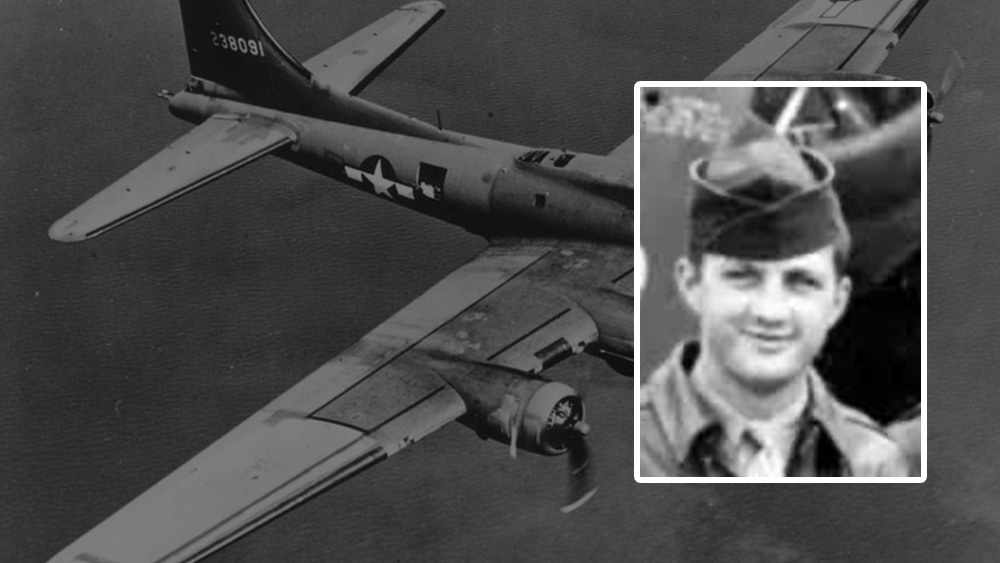
Staff Sergeant Eugene Moran
What happened over northern Germany during WW2 that afternoon sits at the overlap of three things: an Eighth Air Force mission dogged by weather, a bomber already battered by flak, and the ugly randomness of what breaks away when a heavy aircraft finally comes apart.
The mission: Bremen, and a day when many aircraft never reached the target
On 29 November 1943 the Eighth Air Force sent a large force of B-17s towards Bremen, but the day did not play along. Official USAAF chronology records that 154 of 360 heavy bombers attacked Bremen and targets of opportunity, with more than 200 aborting because of cloud and problems with blind-bombing equipment. Thirteen aircraft were lost.
Gene Moran was flying as tail gunner in a B-17F, serial 42-30359, commonly recorded under the nickname “Rikki Tikki Tavi”, from RAF Snetterton Heath, with the 339th Bomb Squadron of the 96th Bomb Group.
Local reporting around Syke, south of Bremen, places the aircraft at roughly 9,000 metres when it exploded and broke apart. (That figure matters mostly because it shows how far the wreckage had to fall. Later tellings often round the distance to “four miles”.
“A loud bang in the sky”: the break-up over Syke
In the Syke area, the event is remembered not as an air combat vignette but as a sudden, violent interruption above a town. A German local history piece describes “a loud bang” overhead and wreckage falling across the eastern part of the town, some of it burning.
It also pins down the basic sequence: heavy flak damage over Bremen, followed by a fighter attack that finished the aircraft off. The bomber exploded and broke into two main sections. Two men survived. Eight did not.
Those two survivors are consistently named across sources: navigator Jesse E. Orrison, who escaped by parachute, and tail gunner Eugene P. Moran, who did not.
The aircraft is tied to Missing Air Crew Report 01392, which places it in the Bremen area and specifically flags Syke.
Gene Moran’s problem was not bravery. It was geometry.
A tail gunner in a B-17 is already working in a tight space. When the airframe behind you twists, bends, or tears, exits that were merely awkward become impossible.
Later accounts describe tail gunner Gene Moran as badly wounded and physically trapped, with damage to the structure around the tail position. One version of the story adds that his parachute was compromised.
Wisconsin Public Radio, drawing on John Armbruster’s long interviews with Moran, describes gunfire and explosions leaving Moran shot through both forearms, with broken ribs, and a bullet through his parachute.
Even if you treat every one of those details cautiously, the central point holds: he was still in the tail when the tail was no longer attached to an aeroplane.
The descent: why a tail section might not tumble straight down
This is the bit everyone wants to argue about, because it sounds like a cartoon. But you do not need magic for it to happen, only a particular kind of failure.
A detached tail unit is not a brick. It has surfaces, internal structure, and a lot of drag. If it separates cleanly enough, it can fall in a messy, oscillating way rather than a simple end-over-end tumble. Think less “glider” and more “falling leaf”. That does not make it safe. It does make it different from a free-fall body.
Moran’s own description is blunt about his mindset in those seconds: “I was conscious all the way down … I just relaxed. I’m going to die. Why fight it?”
It is a human line, not a heroic one, and that is part of what makes it believable.
Some websites also repeat a physical detail that underlines speed and violence: the tail section fell so fast, Moran’s dental fillings popped out.
Impact: trees, woodland, and broken wreckage that hit “less hard” than it should have
Moran and the tail section came down in a forest. Trees and soft ground can act like a crude energy absorber. They add time to the deceleration and tear the structure apart in stages. That does not cancel out the forces. It can just make them survivable, in the same way that a car crumple zone does not prevent a crash but changes what the body takes.
The next problem: being alive on the ground in Germany
Survival was only step one. Moran was now a wounded American airman on enemy territory, alone.
He recalled how he was found by French prisoners of war who were scavenging wreckage, and then German soldiers arrived. Moran was “lucky” it was soldiers who took him in, because locals might have killed him on the spot.
Two doctors in the POW system treated his injuries and, by that account, saved his life.
What people on the ground saw
One of the most useful correctives to the “single-man miracle” framing is the local record. In Syke, the crash is remembered as scattered wreckage, fires, and bodies in streets.
A teacher, Sudenn, writing in a school chronicle, described the field debris in practical terms, down to what was in a rucksack: chocolate and French 100-franc notes. The same local account says a burning fuel tank fell onto a bakery in Waldstraße and the building later burned out.
Moran endured about 17 months in “various POW camps”, with dangerous transfers during bombing raids.
The aircraft and crew
These points are stable across multiple sources:
- Date: 29 November 1943
- Target/area: Bremen
- Aircraft: B-17F, serial 42-30359
- Unit: 339th BS, 96th BG, Eighth Air Force
- Location of loss: near Syke, south of Bremen
- Survivors: Orrison (parachute), Moran (in the tail)
The full crew list is:
- Pilot: 2Lt Linwood Langley – KIA
- Co-pilot: Lt Berline Cipresso – KIA
- Bombardier: 2Lt Don Curtis – KIA
- Navigator: 2Lt Jesse Orrison – POW
- Flight engineer / top turret gunner: T/Sgt Walt Reed – KIA
- Radio operator: T/Sgt Sam Amatulli – KIA
- Ball turret gunner: S/Sgt Wilbert Provost – KIA
- Waist gunner: S/Sgt Anderson King – KIA
- Waist gunner: S/Sgt Edmund Swedo – KIA
- Tail gunner: S/Sgt Eugene “Gene” Moran – POW
Eugene Moran’s survival is the hook people remember, but it shouldn’t be the only thing they take away. Rikki Tikki Tavi was one aircraft in a vast, grinding campaign where weather, flak and fighters could undo a crew in minutes, and where the “miracle” moments were usually paid for by someone else’s loss. The tail section’s fall, the trees that broke it, the capture and the months that followed all sit in the same hard truth: you could do your job, fly your mission, and still be left with nothing but chance and whatever the airframe gave you on the way down. For Moran, that chance kept him alive. For eight of his crewmates, it didn’t.
Incredibly, Eugene Moran’s story isn’t in isolation. Something similar also happened to a man named James Raley.