
If you’re looking for luckiest survivor of the 1945 B-25 Empire State Building crash, you end up with an elevator operator from Arkansas who never set out to become anyone’s legend.
Betty Lou Oliver was working in the Empire State Building when a USAAF B-25 Mitchell, lost in fog, struck the north side of the tower. Eleven people in the building died, along with the three crew aboard the aircraft. Oliver lived through the impact. Then she lived through the part that sounds like an exaggeration even when you know it’s true: a free-fall of roughly 75 storeys in a lift, more than 300 metres, down to the basement.
It is widely recorded as the longest fall survived in a lift. Even the Guiness Book of World Records have recognised it.
So, what is the story of Betty Lou Oliver, an elevator in the Empire State Building, and a B-25 bomber?
It’s an incredible one…
Betty Lou Oliver and the Empire State Building
She was just a young woman in a job that made the building work. The Empire State Building ran on people most visitors never notice. In the mid-1940s, lifts were staffed and managed in a way that feels distant now: operators at the controls, steady routines, a lot of foot traffic, a building that still had the air of a machine. Betty Lou Oliver was one of those workers.
Her age is sometimes reported as 19, sometimes 20. That mismatch is easy to understand if her birthday fell shortly before the crash, and several later accounts describe her as 20.
She was married to a US Navy torpedoman, Oscar Lee Oliver. Photographs taken during her recovery show the pair together, which is likely one of the few reasons her name stayed attached to the story at all: it gave editors a human centre in a disaster that otherwise sprawled across floors, offices and stairwells.
The crash that set everything in motion
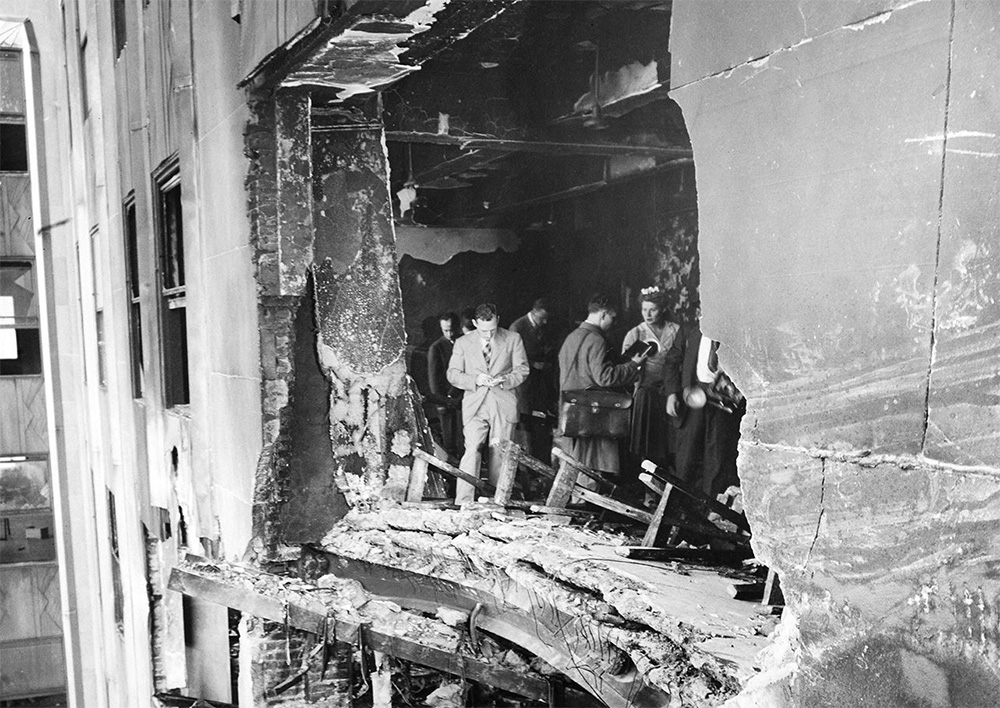
The wider incident has been retold often: fog, a pilot trying to reach Newark, a wrong turn over Manhattan, and the sudden appearance of the Empire State Building out of low cloud. The impact tore a large hole into the upper 70s floors and started fires that firefighters fought using standpipes at extreme height.
One engine fell into an elevator shaft. That single fact matters for Oliver’s story more than any other. It meant damage not only on the impact floors, but deep inside the building’s vertical systems. It also helps explain why the lift incident happened in the first place: the crash didn’t just break windows and set offices alight, it disrupted cables, machinery, and the logic of routes down.
What exactly happened to Betty Lou Oliver in the elevator
Here’s where the history gets slightly untidy, because different accounts place Oliver in slightly different positions at slightly different moments.
One common version says she was thrown from her operating position on or near the 80th floor of the Empire State Building during the impact and suffered serious burns, and that first-aid workers then placed her into another elevator to bring her down, not realising the lift system had been compromised. The car then dropped when its supporting cables failed.
Another version compresses events and puts her already inside the car that fell when parts of the aircraft severed the lifting cables.
The most careful summaries tend to avoid over-precision and state the essential chain: Oliver was injured in the crash, she ended up in an elevator whose cables had been damaged or severed, that lift fell about 75 storeys to the basement, and she was found alive in the wreckage and cut out.
The fall in an elevator: 75 storeys of free space
The record-book framing is blunt: all the lift cables, including the safety cable, were severed, and the lift was in free-fall to the basement. Oliver had to be cut out of the mangled car.
Even if you do not care for records, those two points do the job. A fall that long is the sort of thing buildings are designed to prevent, not survive. The human body is not meant to be in a vehicle accelerating down a shaft for anything like that distance.
Oliver suffered major injuries. Later accounts commonly describe fractures to her neck, back and pelvis, alongside the injuries from the crash itself.
And then she lived.
Why Betty Lou Oliver survived the elevator fall (and why nobody should treat it as “explainable”)
People like a neat, almost mechanical answer to survival stories: “this one feature saved her”. Real life is rarely that clean, and the sources on Oliver’s fall describe a mixture of factors.
Several explanations repeat, and they are not mutually exclusive:
- The elevator / lift’s braking system may have engaged to some degree during the descent
- the cut cables likely piled up at the bottom of the shaft, acting like a crude spring
- air pressure in a relatively tight shaft can resist the falling car, like a piston effect
- the buffer system at the bottom of the shaft (designed for emergencies) may have absorbed some energy at impact
None of that turns a falling elevator in a lift shaft into a safe ride. What it offers is a slight reduction in the violence at the very end, plus a handful of small resistances during the drop. In an event where the expected outcome is death, “slightly less force” is the difference between a miracle story and an obituary.
There’s also an important framing point. Oliver survived with serious injuries. Survival here does not mean “walked away”. It means she was still alive when rescuers reached her in the basement and fought to get her out.
Rescue and the practical work of getting her out
The lift did not stop neatly on a floor. It crashed into the bottom of the shaft. Accounts agree that Oliver had to be cut free from twisted metal.
That detail matters because it reminds you how limited medical care is until somebody physically reaches you. In a high-rise disaster, the difference between life and death is often about access: stairwells, smoke, broken lift service, confusion about which routes still work. The same crash that injured Oliver also made it harder for rescuers to reach the floors where people were trapped, and it created hazards down in the basement as well.
Recovery, publicity, and a life that mostly belonged to her
Betty Lou Oliver and her elevator story meant she became a public “face” of the incident for a while, largely because photographers could follow her recovery. Period captions and later retellings sometimes called her the “Sunshine Girl” for her cheerfulness. She appears in photographs reunited with her husband, still on crutches months after the fall.
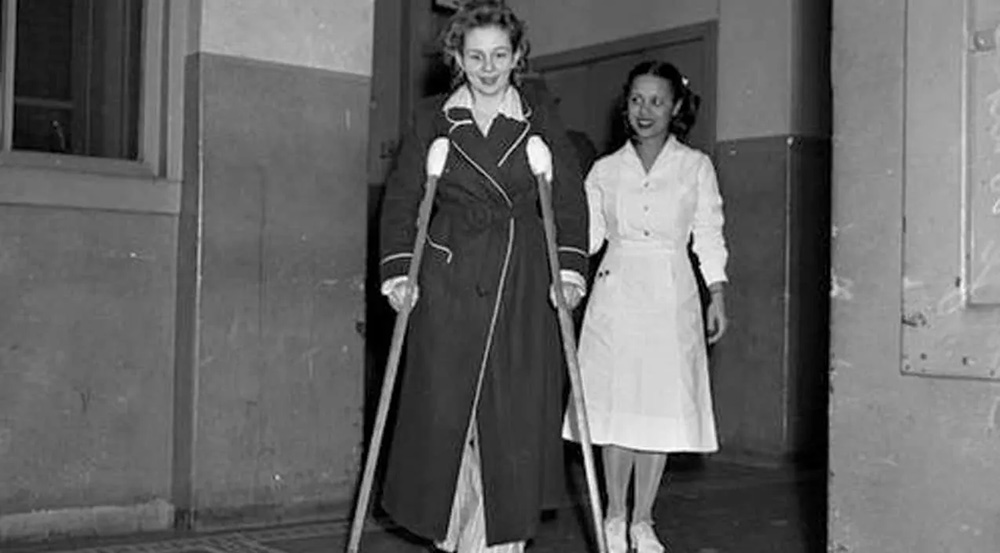
That kind of label can sound glib now, but it fits the way mid-century newspapers handled catastrophe. Editors wanted a hopeful thread, and a young woman walking again was easier to print than the burnt-out offices on the 79th floor.
Later accounts say she returned to Arkansas and rarely spoke about what happened. She died in 1999.
The record, and what it’s really saying
It is tempting to treat the “world record” for the “longest fall survived in a lift (elevator)” as a quirky statistic. It’s more revealing than that.
Records have a way of turning catastrophe into trivia, but they also preserve facts that might otherwise blur. In Oliver’s case, the record keeps three things firmly in view:
- this happened on a known date, at a known place, during a well-documented disaster
- the fall was not a few floors or a “drop”, but tens of storeys
- she did not “get lucky” in the casual sense, she survived something that is supposed to be unsurvivable, and she paid for it in injuries
What we still don’t know cleanly
Even with decent sourcing, there are gaps and overlaps.
The biggest is the precise sequence of how Oliver came to be in the lift car that fell. Some tellings make it part of an evacuation attempt, others imply she was in the lift when the cables were severed. The difference might come down to retelling habits rather than new evidence, and it’s not something you can settle cleanly without going back to the most detailed original investigative files.
There’s also the question of numbers: “75 storeys” is consistent, but “70 storeys” appears in some captions and summaries too, which may reflect different ways of counting floors versus the distance travelled to the pit and sub-basement.
The plainest way to look at it
If you strip away the record label, the photographs, and the retellings that lean too hard on wonder, Oliver’s story is still remarkable for a simple reason.
She was an ordinary worker in the Empire State Building that became the site of an extraordinary accident. She was hurt in the initial impact. Then a second, separate mechanical failure turned her evacuation into a fall that should have killed her. She survived because a set of safety systems and physical conditions partially did their job, and because fortune, in the narrowest sense, didn’t finish her off.
After that, she recovered enough to live a full life.
And the lift kept falling in people’s imaginations, long after it stopped in the basement.