On Saturday morning, 28 July 1945, New York was running at weekend pace. Europe’s war was over, Japan’s was nearing its own finish, and Manhattan’s biggest building sat inside a lid of low cloud. People still went up to the observation deck, even though there was very little to see. Offices were open too, just thinner staffed than a weekday.
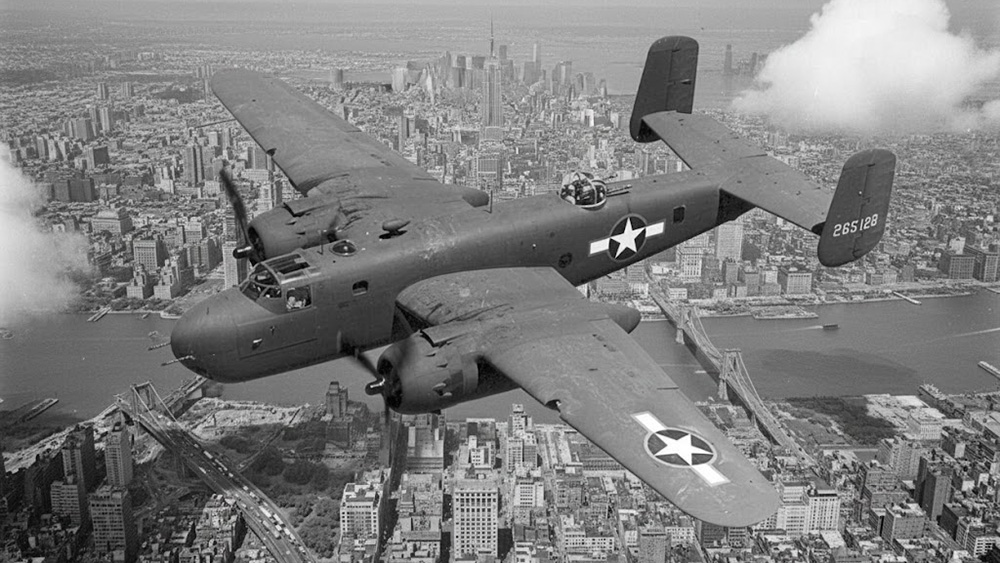
A few minutes before 10 a.m., a US Army Air Forces B-25 Mitchell bomber came out of that fog at low level over midtown. It was a twin-engined medium bomber, the kind Americans associated with wartime photographs and the Doolittle Raid. This one was not on a combat mission. It was being used as transport, with its armament removed and its bomb doors sealed. It carried a full load of high-octane fuel, the sort of detail that becomes painfully important once the aircraft stops being an aeroplane and turns into a flying fuel tank.
The B-25 hits Empire State Building.
The Day a B-25 Crashed into the Empire State Building
The impact of the B-25 crash into the Empire State Building killed 14 people: the three on board and 11 in the building. About two dozen others were injured. That is the clean summary. The day itself was anything but clean.
The crew: experienced, young, and unlucky
The pilot was Lieutenant Colonel William F. Smith. He was 27, West Point class of 1942, deputy group commander of the 457th Bomb Group. He had serious combat time, including dozens of missions over Europe in heavy bombers. By reputation he was a good man in a cockpit, not some green flyer blundering into the city by carelessness.
With him was Staff Sergeant Christopher S. Domitrovich, described in later department accounts as a crew chief and engineer who had flown missions in Europe and, at one point, parachuted out over German-controlled territory and evaded capture with local help. He and Smith had only met days earlier. This was not a crew with long habits together, which matters when things begin to go wrong quickly.
The third man was not meant to be there at all. Navy Aviation Machinist’s Mate 2nd Class Albert Perna approached the aircraft at Bedford Army Air Field just before it taxied and asked for a lift. His brother had been reported killed in action and he was trying to get home. Smith did not want extra passengers, but he let him on. Perna’s presence is one of those small human decisions that turns a chain of errors into a personal catastrophe.
The aircraft itself was a North American B-25 Mitchell bomber with the nickname “Old John Feather Merchant” and tail number 41-30577. Contemporary-style summaries give a departure time of 08:52 from Bedford, Massachusetts, with a plan to reach Newark via the New York area.
A 1945 problem: fog, traffic, and flying “by contact”
If you want to understand how this happens, you have to sit in 1945 for a moment and forget what you know about modern navigation and controlled airspace.
That morning was humid and foggy, with a low ceiling. Smith wanted to fly under instrument flight rules, but in the accounts that survive, he was denied because the instrument system was already busy with civilian traffic in the bad weather. He chose to continue under “contact flight rules”, essentially meaning he intended to keep visual contact with the ground and remain at or above a minimum altitude. If he could not do that, he was meant to turn back.
As visibility worsened, he requested instrument clearance again near LaGuardia. He was held, then eventually permitted to continue towards Newark. Controllers warned him that the top of the Empire State Building was not visible.
That warning reads like a line in a script now. It wasn’t. It was a factual statement about a very tall obstacle sitting inside fog.
Losing the map inside the cloud
The key moment was not the impact. It was the quiet minute where Smith stopped being sure where he was.
Accounts describe him mistaking Welfare Island (now Roosevelt Island) for Manhattan. He saw water on the far side and believed it was the Hudson, meaning he thought he had crossed the city and was over New Jersey. He turned left, dropped lower to stay beneath the cloud layer, and even lowered the landing gear of the B-25 bomber as if preparing to arrive at Newark. In reality, he was still over the East River and was now lined up to fly south down the spine of Manhattan at low altitude.
Witnesses later described the aircraft roaring past buildings so closely that people could see faces in the cockpit. There were near misses as he threaded between towers. He then began retracting the landing gear, realising his position was wrong.
Then the Empire State Building came out of the fog in front of him.
Smith hauled back and banked right. There was not enough room. The B-25 hit the Empire State Building around the upper 70s floors. Reported times vary in different accounts, which is common in fast-moving disasters, but the sequence is not in doubt: a low, fast aircraft in thick fog met a skyscraper it could not see in time.
The crash impact: steel, stone, fuel
The B-25 crashed into the Empire State Building on the north side around the 78th and 79th floors. The collision force ripped an opening roughly 18 by 20 feet through the façade.
Fuel ignited on impact of the crash. People at street level saw a burst of flame out of the side of the building, a brief inferno that lasted minutes. Upstairs, the fire spread through offices, paper, furniture, and partitions. Later official reporting described severe life hazard and the risk of panic in the building, with people trapped and others exposed to heavy smoke and heat.
One of the B-25’s engine punched clean through the building and ended up on a nearby rooftop, causing a separate fire. The other engine and parts of the landing gear fell into elevator machinery and shafts, compounding the damage.
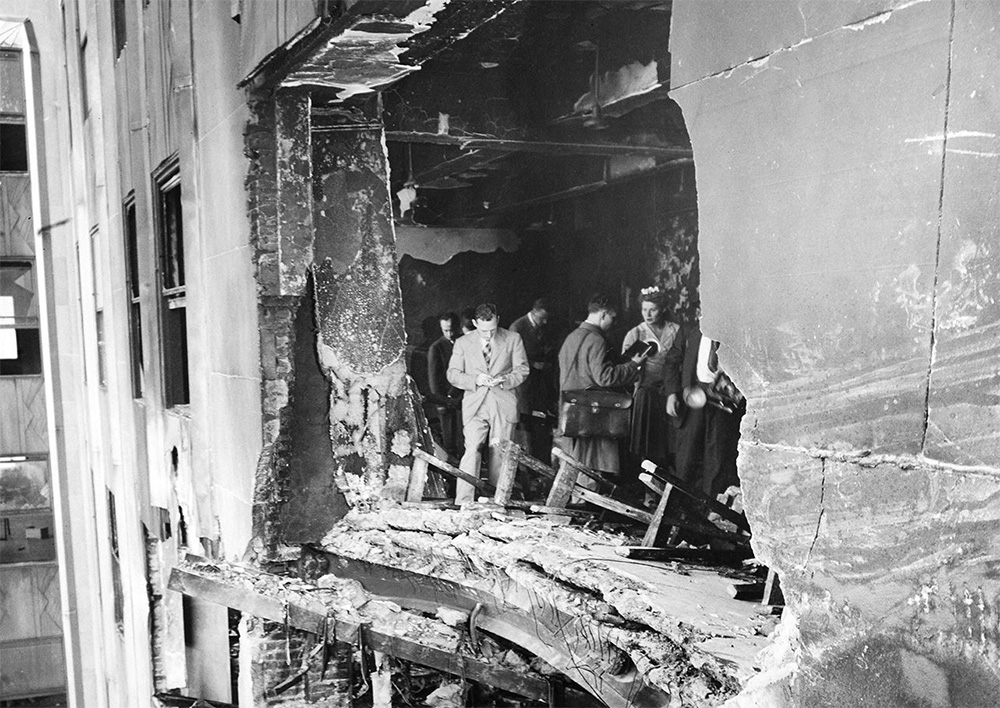
This is the part that people sometimes get wrong when they talk about how the Empire State Building survived an aircraft strike. The building’s steel frame did its job, but the internal damage was still savage: offices torn apart, burning fuel inside a high-rise, debris and metal travelling places you do not expect.
Who was up there: victims and the particular cruelty of a Saturday
The dead in the building were largely office workers on the impact floors. One major tenant on the 79th floor was Catholic War Relief Services, with staff in on a Saturday. Later narrative accounts name individuals there, giving a sense of an office that was ordinary one moment and destroyed the next.
One detail that is both mundane and grimly important: it was a Saturday. Fewer people were in the building than on a weekday, which almost certainly reduced the death toll. Retrospectives have put the number of occupants in the building at roughly 1,000 to 1,500 at the time, far below a normal workday load.
Some victims of the Empire State Building B-25 crash died immediately. Another, widely identified in later accounts as Joseph “Joe” Fountain, succumbed to burns days later, which is why some retellings mention “10 killed outright” while still arriving at 11 building fatalities overall.
If you read survivor accounts, what stands out is not screaming or hero speeches. It’s how quickly offices turn into compartments of smoke and heat, and how staff fall back on half-learnt drills: shut doors, stay low, find a staircase, follow someone who seems to know the way.
People on other floors felt the building shudder and assumed, for a moment, that the tower itself might be coming down.
The elevator fall: Betty Lou Oliver and the physics of a miracle
The best-known survivor story belongs to Betty Lou Oliver, a 20-year-old elevator operator. She was on duty that day and was badly injured in the initial crash and fire. What followed is the sort of event that, if it weren’t documented, would sound invented.
Oliver ended up in an elevator car whose cables had been compromised by the crash. The car fell about 75 storeys, more than 300 metres, all the way to the basement. It is widely recorded as the longest fall survived in a lift.
Why did she live?
No single factor “explains” it, but several things likely helped. Later accounts point to a mix of cushioning effects: severed cables piling in the shaft like a spring, and air pressure in a relatively tight shaft resisting the fall. Modern commentary often adds the presence of the oil buffer system at the bottom of the shaft, designed to take a descending car’s energy in an emergency. None of that makes the fall safe. It makes it marginally less lethal, which is all you get in a situation like that.
Oliver was cut out of the wreckage at the bottom and eventually recovered. Some accounts say she was back on her feet within months, which is astonishing on its own.
Her story also shows how disasters generate “single-character narratives”. Most people remember the elevator fall. Fewer remember that 14 people died, that dozens were injured, and that a serious high-rise fire was fought almost a thousand feet above street level.
Fighting a high-rise fire in 1945
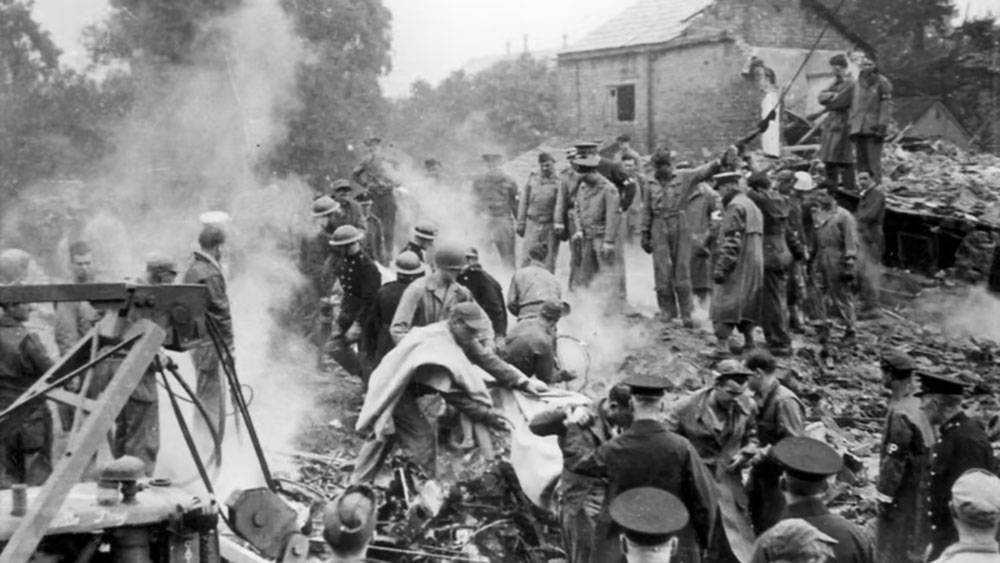
The fire department response to the Empire State Building B-25 crash was immediate and, by any measure, hard.
Fire at the 78th–80th floor level creates problems that are still difficult today: time lost in vertical travel, heavy hose and equipment up stairwells, smoke moving unpredictably through shafts, and a standpipe system that you have to trust in order to have any water at all.
Official reporting placed the fire roughly 913 feet above the street and described a large response, using standpipe-fed hose lines to reach and suppress the fire. The fires were brought under control quickly and extinguished within about 40 minutes.
Even allowing for slightly different timings (receipt of alarm vs arrival vs water on the fire), the core point holds: they managed to contain and extinguish a major fire at a height that was then almost unimaginable for firefighting operations.
Rescue was not only a matter of uniformed services. Building staff guided people, relayed information, and kept some order in stairwells and lobbies. In disasters, “the system” is usually a patchwork of professionals and whoever happens to be nearest, doing the next practical thing.
Donald Molony: running towards the smoke
One of the better-documented civilian rescuer stories involves Donald Molony, a 17-year-old Coast Guard trainee in the city that day.
Accounts differ in small particulars, but the main outline is consistent: Molony reached the scene, obtained medical supplies, and assisted in treating and moving injured people, including aiding Oliver after the elevator disaster.
The narrative is useful not because it produces a tidy hero, but because it shows what actually helps in emergencies: basic training, quick improvisation, and a willingness to be directed.
What the investigation into the B-25 crash concluded
Authorities quickly framed the B-25 collision into the Empire State Building as being attributed to pilot error in bad weather. Later summaries emphasise the warning about visibility, Smith’s decision to continue, and the navigational mistake that placed him over Manhattan instead of on a safe line towards Newark.

If you want a more charitable reading, it is not that Smith was reckless in the childish sense. It is that the systems around him were thin by modern standards, and the margin for error in low cloud over the densest cluster of tall buildings in America was close to zero. In that environment, “human error” becomes less an insult and more a description of a cockpit that ran out of good options.
The Empire State Building did not fall: what that does and doesn’t mean
The Empire State Building’s steel frame held after the B-25 hit. That fact has been used ever since as a talking point in other debates about aircraft impact and tall buildings, often without much care.
A more grounded view is simple: the structure remained standing, but with serious local damage and a major internal fire. The building’s survival was not proof that aircraft impacts are harmless. It was proof that a 1930s steel-frame skyscraper can take a blunt, relatively small aircraft at moderate speed and still remain globally stable.
Repair work began quickly. Many floors reopened within days, and the building returned to normal operation while damaged areas were rebuilt. That rapid return to service became part of the building’s legend, but it also reflects something plain: New York could not afford to leave a major commercial landmark closed for long.
The legal afterlife: compensation, lawsuits, and the Federal Tort Claims Act
The B-25 crashing into the Empire State Building also lives on in law, not only in memory.
Retellings often link this incident to changing American rules around suing the federal government. In the version that persists in public memory, the government offered compensation to families; some accepted, others pursued action that became entangled with landmark changes, including the Federal Tort Claims Act of 1946.
It is worth keeping that phrasing careful. The Act had been discussed and proposed before 1945. The Empire State Building case is better understood as a powerful example used in arguments about sovereign immunity and fairness, and as a practical test case once the law existed, rather than the single “cause” of the Act.
Myths, disputed details, and what’s hard to nail down
A few points remain messy because this was a fast, chaotic event with overlapping jurisdictions.
- The exact time of the B-25 impact is reported differently in different later sources. That’s not unusual: “time of crash” can mean first distress call, first impact, or time noted in an official log.
- Numbers around injuries and immediate fatalities can vary depending on whether you count later deaths (such as burn victims) and which hospitals’ tallies you follow.
- Some high-profile retellings contain small errors or inconsistencies in dates and labels, even while getting the main story right.
Those caveats do not weaken the history. They are part of it. Real events are not built out of perfectly aligned timestamps.
What the day left behind
The 28 July 1945 crash sits in an odd place in New York memory: a huge event, genuinely spectacular, and yet often forgotten because it happened between larger chapters of the century.
It is, at heart, a story about ordinary risk becoming extraordinary. A routine transport flight, a fog bank, an argument over clearances, a wrong turn over water, and then the most famous building in America appearing at the worst possible moment.
After that, it is a story about people doing what they can: office staff finding refuge behind doors, firefighters hauling hose up into heat and smoke, medics and bystanders working in the street, and an elevator operator who survived because a handful of physical details happened to line up in her favour.
And it is a reminder that “accident” does not mean “inevitable”. It means the opposite: a chain of decisions and conditions that, in different weather or with different rules, might have ended with everyone going home.