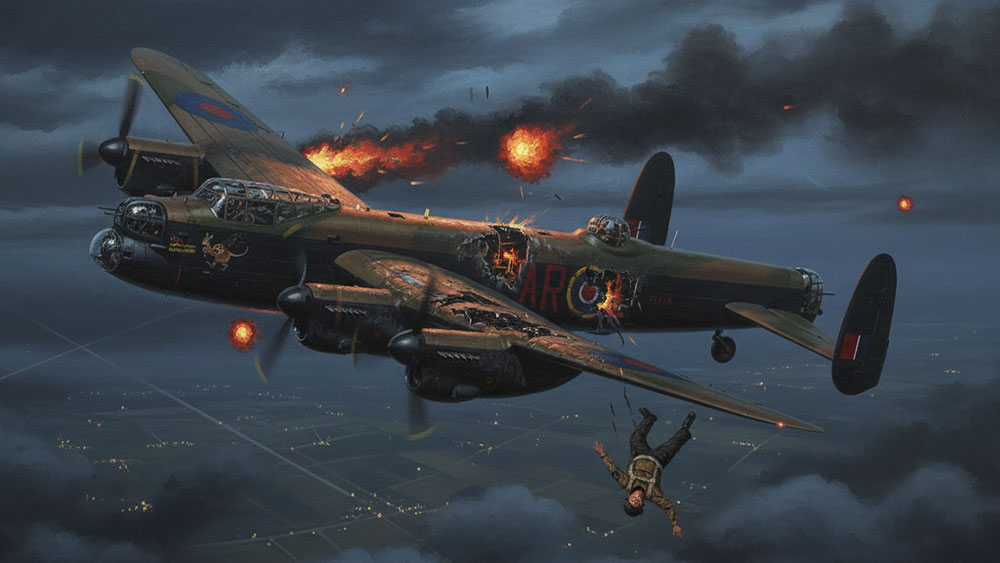

Just after midnight on 13 June 1944, a Lancaster was coming apart in the dark over northern France. A German night-fighter attack had knocked out both port engines – fire was now running through the rear fuselage. The captain gave the order that bomber crews all dreaded and had to practise for: abandon aircraft.
Andrew Mynarski was the mid-upper gunner. He moved from his turret and inched towards the escape hatch. Then he saw the rear gunner was still in place, stuck in a turret that could not be moved. Mynarski turned, and in an extreme act of bravery, went back into the fire. He attempted to free his comrade, but to no avail. By the time he retreated, his parachute and his clothing were burning. At the hatch he paused, stood to attention in his flaming clothing and saluted, then jumped into the cold dark air.
That is the core of the story, and it sounds like something from a comic. But it’s not folklore or fantasy. It appears in the official Victoria Cross citation, published in the London Gazette in October 1946.
This is the story of how Canadian Andrew Mynarski was awarded the Victoria Cross.
Andrew Mynarski VC
What follows is context and reconstruction: who Mynarski was, what 419 (Moose) Squadron was doing that week after D-Day, why a Lancaster turret could become a death-trap in seconds, and how the one man who could tell the tale, the rear gunner, survived to do exactly that.
The raid: why Cambrai mattered in mid-June 1944
The timing is not incidental. The Allied landings in Normandy were a week old. The battle on the ground depended on choking German reinforcement and supply routes, especially rail. On the night in question, Bomber Command wanted to hit communications targets in France, mostly railways, including Cambrai. Contemporary summaries note that Cambrai was hit but many bombs also fell in the town, and that losses were heavy across these raids.
Cambrai’s rail yards were one of the points of friction the Allies wanted to tighten. It was a practical target at a practical moment: break the movement of men, fuel, ammunition and armour towards Normandy.
No. 6 Group was the Canadian group within RAF Bomber Command, and Cambrai was one of its tasks that night. Records of the operation describe a force of Canadian (RACF) squadrons attacking the rail yards at comparatively low bombing heights for a main force raid, dropping large loads of high explosive.
The point to hold on to is this: Mynarski’s aircraft was part of a big, purposeful attempt to disrupt German movement at a moment when the invasion’s outcome was still being fought for kilometre by kilometre.
The squadron: 419 “Moose”, and a new Lancaster crew
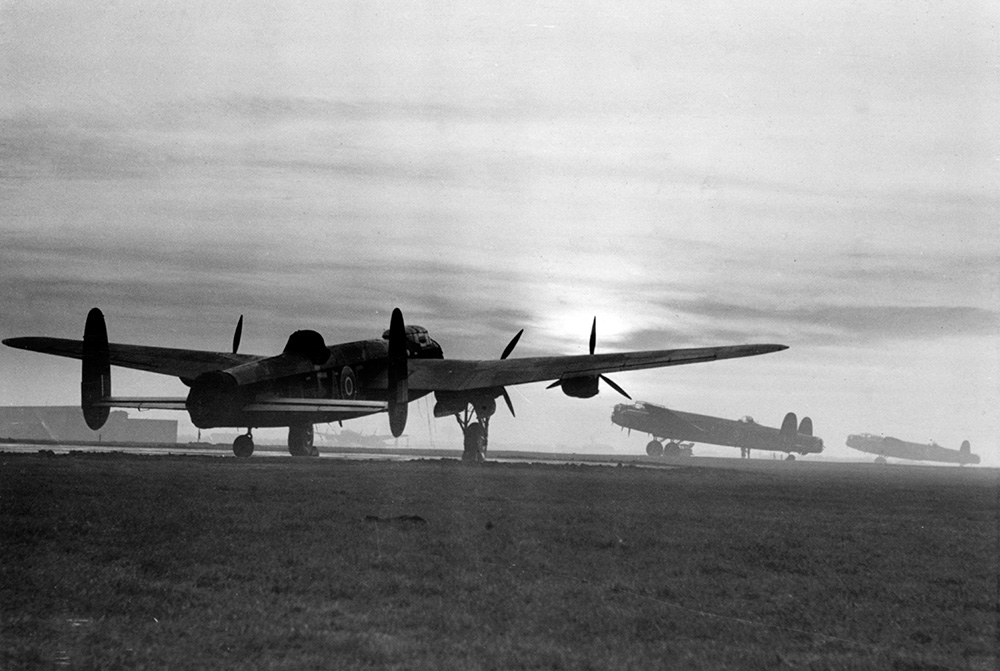
No. 419 Squadron RCAF had already taken punishment earlier in the war. By spring 1944 it had converted to Lancasters and operated from RAF Middleton St George in County Durham.Mynarski himself had only recently arrived on squadron. He was the mid-upper gunner of a 419 Squadron Lancaster on the night of 12–13 June 1944.
The aircraft in question was Lancaster Mk X KB726, coded VR-A.
The crew comprised of the pilot, Arthur De Breyne. The rear gunner was George Patrick “Pat” Brophy. Other crewmen included A. Robert Bodie, John William Friday, Roy Ernest Vigars and W. James Kelly.
It’s believed that this was the crew’s twelfth or thirteenth operation together. Sources differ, and the official citation does not settle it. It is safest to say only that the crew were early in their tour.
The man: Andrew Charles Mynarski, Winnipeg, and the RCAF
Mynarski was born in Winnipeg on 14 October 1916. He was educated locally. After his father’s death he worked as a leather worker to help support his family. In 1940 he joined the Royal Winnipeg Rifles militia briefly, then enlisted in the Royal Canadian Air Force in 1941.
That matters because it places him in the broad pattern of young men who moved between branches as the war’s needs shifted and as recruiting channels opened. It also hints at something that comes through in almost every account of him, official and unofficial: he was not portrayed as reckless. He was portrayed as steady, well-liked, and dependable.
What a Lancaster gunner faced, and why the rear turret could trap you
It is hard to read the Victoria Cross citation for Andrew Mynarski without picturing a man going back into fire and smoke. But the citation is also a technical description of how a Lancaster worked.
Lancaster turrets were normally powered by hydraulics. If hydraulics failed, some turrets had manual systems. The rear turret also had a brutal practical requirement: to get out, the gunner usually needed the turret aligned to a specific position. If the turret jammed part-way, escape could become impossible.
The citation states that the rear turret was immovable because the hydraulic gear had been put out of action when the port engines failed, and that the manual gear had been broken in Brophy’s attempts to force his way out.
That line is doing a lot of work. It tells you Brophy had tried. It also tells you that Mynarski, coming up from the mid-upper position, was facing a turret that could not simply be opened with calm hands and luck.
The attack and the fire: reconstructing the last minutes of KB726
The VC citation is clear about sequence. The aircraft was attacked from below and astern by an enemy fighter, after which both port engines failed. Fire broke out between the mid-upper and rear turrets and also in the port wing and grew fierce enough that the captain ordered abandonment.
Detailed research accounts often identify the attacker as a Ju 88 night-fighter and attribute the claim to a named Luftwaffe pilot and unit at a specific time. These details are useful as researched attribution, but they are not part of the VC citation itself.
What does appear consistently, across official and compiled accounts, is the basic geometry of what happened next: the rest of the crew were getting out by the forward escape route; Mynarski moved aft and found the rear turret jammed; he forced his way through heat and flame to reach Brophy; he tried to move the turret; Brophy signalled that he should leave; Mynarski retreated and jumped.
There is one gesture that has carried the story for decades because it is so specific and so human. The VC citation states that Mynarski turned towards the trapped gunner, stood to attention, and saluted.
Some later accounts add reported words, often rendered as a familiar sign-off between the two men. Those words do not appear in the citation, so they are best treated as later recollection rather than something the official record confirms.
Andrew Mynarski on the ground: found by French civilians, dead from burns
The VC citation says his burning descent was seen by French people on the ground; that he was found eventually by the French; and that he died from the severity of his burns.
Later official summaries repeat the same essentials: he landed alive, was found, but died of his injuries.
Where exactly he died, and the precise chain of custody between civilian rescuers and any local medical facility, varies in retellings. It is plausible that he was taken to a German medical post or hospital given the area was occupied, but that detail is not stated in the citation.
His burial is firm though.
He is buried in Méharicourt Communal Cemetery in France.
The man in the turret: how Pat Brophy survived
If Mynarski’s act is the centre, the rear gunner’s survival is the hinge. Without Brophy, there is no eyewitness to the attempt, no testimony, no push through the system to a Victoria Cross for Andrew Mynarski.
The VC citation describes Brophy’s escape as miraculous. It says he later testified that Mynarski, had he chosen to save himself immediately, could have left the aircraft in safety and would likely have survived.
Official Canadian summaries state that Brophy survived the crash of the abandoned Lancaster and, with help from the French Resistance, was back in England by September 1944. Compiled research accounts give fuller versions of how he avoided capture and moved through occupied territory, but the key point is consistent: he lived, and he came back.
Even if you strip away every flourish, the survival is still extraordinary. A rear turret was a cramped, exposed position at the best of times. That night it became a locked capsule inside a burning aircraft. Brophy lived through the impact and the wreck and then lived through occupied France long enough to get home and tell people exactly what Mynarski tried to do.
The award: why the VC was published in 1946
Mynarski died in June 1944. The VC was not published until October 1946. That gap is part bureaucracy, part chaos, and part the fact that key witnesses were scattered: evaders making their way back through Resistance lines, prisoners of war, and a squadron still flying a hard tour.
Accounts of the process state that in late 1945 the pilot, Arthur De Breyne, began the formal push for recognition of Mynarski’s action. The recommendation moved up through the RCAF and RAF command structure. Mynarski was posthumously awarded the Victoria Cross, and also commissioned as a Pilot Officer on 11 October 1946.
The definitive document remains the London Gazette citation itself. It names him, his unit and service number, summarises the action, and ends with the judgement that it was a most conspicuous act of heroism calling for valour of the highest order.
“First” and “last”: where Mynarski sits among Canadian air VCs
Andrew Mynarski is often described as the first RCAF man whose actions in the Second World War earned a Victoria Cross.
There is an important nuance. Another Canadian airman, Flight Lieutenant David Hornell, received a Victoria Cross for an action later in June 1944, and his award was published during the war. Mynarski’s action came earlier in the month, but his award was published later, after the war.
So Mynarski’s act was earlier, but the paperwork landed later. That is not a contradiction. It is a reminder that gallantry awards follow paper trails, and paper trails follow witnesses.
Some accounts also describe Mynarski as the last Canadian serviceman of the Second World War to be awarded the VC, which is consistent with the late publication date in 1946.
Here’s a list of all 16 Canadian VC recipients from WW2, including Mynsarksi.
- BAZALGETTE, Ian W.
- COSENS, Aubrey
- CURRIE, David Vivian
- FOOTE, John Weir
- GRAY, Robert Hampton
- HOEY, Charles Ferguson
- HORNELL, David Ernest
- MAHONY, John Keefer
- MERRITT, Charles C.I.
- MYNARSKI, Andrew C.
- OSBORN, John Robert
- PETERS, Frederick Thornton
- SMITH, Ernest Alvia
- TILSTON, Frederick Albert
- TOPHAM, Frederick George
- TRIQUET, Paul
How he has been remembered: statues, trophies, and a flying Lancaster in his codes
A story like this tends to attach itself to places.
In France there is the grave at Méharicourt, and there are memorial markers near the crash area.
In County Durham, a bronze statue was unveiled at the former RAF Middleton St George site, now part of Teesside Airport, in June 2005.
In Canada, Mynarski’s name is attached to an award: the Mynarski VC Memorial Trophy. It began as a trophy presented in the late 1950s and was later repurposed as a top-level Canadian award for excellence in the field of air search and rescue.
And then there is the aircraft that people see. At the Canadian Warplane Heritage Museum in Hamilton, Ontario, the museum’s flying Lancaster is dedicated to Mynarski’s memory and painted in the markings of KB726 VR-A.
That is not a small thing. Most Bomber Command aircraft left nothing behind but crash sites, aluminium fragments, and names on headstones. A living, flying memorial in the same codes is a rare kind of continuity.
And as a final thought… Lancaster gunners trained for the possibility of fire and turret failure, but no training makes go back through the flames a routine decision. Mynarski did it because he saw a crew-mate trapped, and because at that moment he judged that trying was the only acceptable choice.
That judgement is why the citation reads the way it does, and why it still lands with force eight decades later.