The first people to see Alan Eugene Magee arrive did not see an airman. They saw an object coming down out of cold air, fast enough to make any explanation feel pointless. It hit the glass roof of the railway station at Saint-Nazaire, punched through, and ended up tangled against the ironwork.
And then it moved.
That detail is the hinge of the story. Not because it turns the event into a “miracle”, but because it forces you to look twice at the machinery of bomber war in 1943: cramped crew stations, oxygen systems, flak damage that cascaded into chaos, and the blunt fact that parachutes were not always where you needed them to be when the aircraft started to come apart.
This is the story of Alan Magee’s fall from a B-17 and how he lived to tell the tale.
The story of Alan Magee & his fall
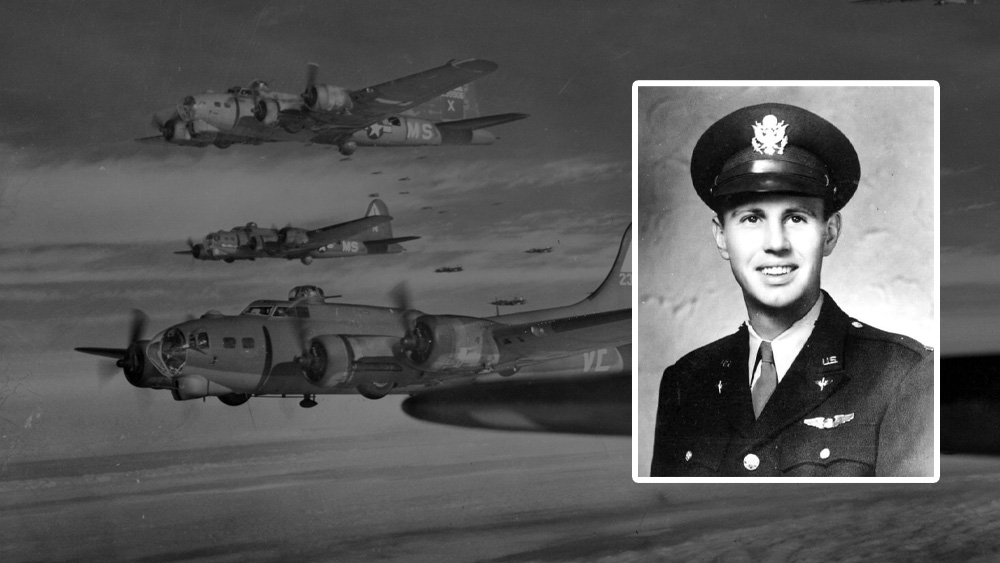
Alan Eugene Magee was a staff sergeant in the United States Army Air Forces, serving as a ball turret gunner on a B-17 Flying Fortress. On 3 January 1943, during a raid against targets around Saint-Nazaire, he fell from his aircraft from roughly 20,000 feet and survived. Later retellings often round the height up to 22,000 feet. The contemporary unit narrative that records the incident uses “about 20,000”. That difference matters less than the reality behind it: he fell from high altitude, without a working parachute, and lived.
The ball turret problem: why some men didn’t have a parachute on them
Before the raid, it’s worth understanding Alan Magee’s position in the aircraft, because it explains a lot of what followed.
The Sperry ball turret sat under the belly of the bomber. It was a powered sphere with twin .50 calibre guns, designed to protect the bomber from attacks from below. The gunner operated it curled up, knees raised, in a space so tight that “fetal position” is not metaphor, it’s the job description. The US Air Force museum’s own summary makes the point plainly: ball turret gunners like Alan Magee squeezed into that position to man the turret, and they were often selected for being the smallest man on the crew.
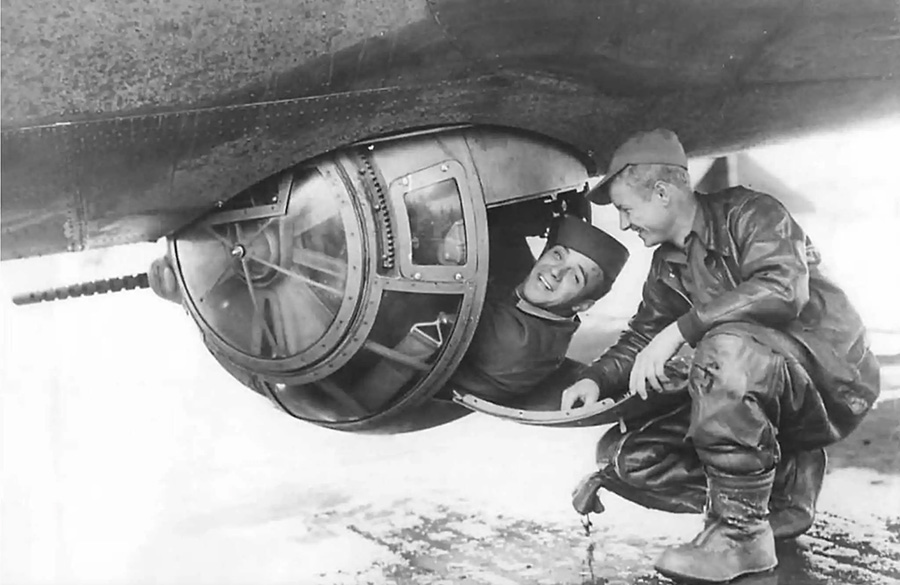
That cramped geometry had a second consequence. There wasn’t room for a normal back-pack parachute inside the turret. Many gunners used chest parachutes, but even then, those chutes were vulnerable to damage, awkward to wear and secure, and in emergencies they could be separated from the man who needed them. When the aircraft was steady and the intercom worked, you could think your way through the drill. When you were wounded, low on oxygen, and the fuselage had started spinning, you often couldn’t.
Gunner Alan Magee’s story sits right on that edge between procedure and panic.
Mission 9: Saint-Nazaire, 3 January 1943
On 3 January 1943, B-17F serial 41-24620 flew as part of the 303rd Bomb Group. The aircraft carried the name “Snap! Crackle! Pop!”, a private joke turned nose art. The group history notes that the nickname came from a pilot who’d worked for Kellogg before joining the Army Air Forces.
The raid targeted facilities connected to the German war effort around Saint-Nazaire. The city mattered because it was a U-boat base and a defended Atlantic port. The air over it was thick with flak, and early-1943 raids were still taking place before long-range fighter cover was routine. B-17 crews went in exposed and paid for it.
The B-17 Alan Magee was in did not merely get “hit”. According to the group’s mission narrative, the ball turret took flak damage that wounded Magee and made the turret inoperative. He left the turret and discovered his chest parachute pack had been damaged, with a large hole and one end affected. He did not strap it onto his harness.
That small decision can look baffling from an armchair. In context, it reads like a man doing a fast, cold calculation with incomplete information. A badly damaged parachute could kill you as efficiently as no parachute at all, and it could also tangle, snag, or slow your movement through the aircraft when seconds matter.
Then the situation got worse.
The fall of Alan Magee: what the record actually says
The mission narrative describes the next stage in a way that feels almost matter of fact, which is often how these things are written when the writer has seen too much to romanticise it.
After Magee moved into the bomb bay area, the aircraft sustained a direct flak hit and went into a tight spin. Magee, wounded again, tried to reach the radio room hatch. At some point during this, he blacked out from lack of oxygen and was tossed out of the hatch without a parachute.
That sequence matters. It wasn’t a deliberate leap. It wasn’t a man stepping into space. It was a wounded airman losing consciousness in a violently manoeuvring aircraft and being thrown out through an opening.
The same narrative records what happened next: unconscious, he fell “about 20,000 feet”, crashed through the glass roof of Saint-Nazaire railroad station, and became tangled in the steel girders. Germans cut him down. A German doctor saved his arm, described as nearly torn off, and repaired extensive damage to his teeth, leg, knee and ankle. Magee passed through hospitals and prisoner of war camps and remained a POW until the end of the war.
That is the core of the story, and it is already extraordinary without embellishment.
How did Alan Magee survive the fall?
There’s a temptation to treat survival stories as puzzles with neat solutions. Usually, they aren’t.
What can be said, without pretending to do physics on a human body that fell through a roof in wartime, is this:
- Sgt Alan Eugene Magee was unconscious for at least part of the fall. Unconsciousness doesn’t make impacts safe, but it can prevent the kind of muscle tension that turns some injuries lethal.
- He did not hit solid ground in one clean, final collision. He went through a glass roof and ended up caught in ironwork. The energy of the fall was bled off in stages, not all at once.
- He was dressed for high-altitude cold in a B-17, which meant multiple layers. That doesn’t stop broken bones, but it can reduce cuts and tearing when glass and metal are involved.
Anything beyond that becomes guesswork. The important point is simpler: the station roof and its structure turned a clean fatal impact into a chaotic, injuring, survivable one.
Captivity, treatment, and the long remainder of WW2
Once Magee was in German hands, his story becomes less cinematic and more familiar to anyone who’s read POW accounts.
He was seriously injured. The group narrative stresses the medical work done by German doctors, including saving his damaged arm. Then came the system: hospitals, interrogation, movement between camps, and time. Lots of time.
That time is easy to skip past in a dramatic retelling. It shouldn’t be. Even for a man who survives the fall, the war doesn’t stop asking for payment. Pain, reduced mobility, dental reconstruction, and the mental toll of captivity are not footnotes. They are the bulk of the experience.
Alan Eugene Magee was liberated in May 1945. He received the Air Medal and the Purple Heart, and later in life his survival became the part of his service most strangers knew. That’s understandable, but it can also shrink him into a headline: the man who fell.
He was more than that. He was a crewman in a machine designed for long, cold hours, whose survival depended on training, luck, and the structure of a railway station roof in occupied France.
How the story of Alan Magee’s fall and survival travelled after the war
By the late twentieth century, Magee’s fall had become a staple of wartime “most amazing survival” lists. Saint-Nazaire itself also remembered. Accounts differ on whether the key commemorations were marked in 1993, 1995, or across both years through different ceremonies, but the underlying point is solid: the city and local supporters treated the incident as part of their wartime memory, not just an American anecdote.
That’s another useful corrective. These events happened in lived places. Saint-Nazaire wasn’t a backdrop. It was occupied territory with its own dead, its own bomb damage, and its own complicated relationship with Allied raids. Magee’s survival landed, literally, inside that reality.
A comparison worth making: Nicholas Alkemade
If you want a single comparison that clarifies what is distinctive about Magee’s fall, it’s Nicholas Alkemade.
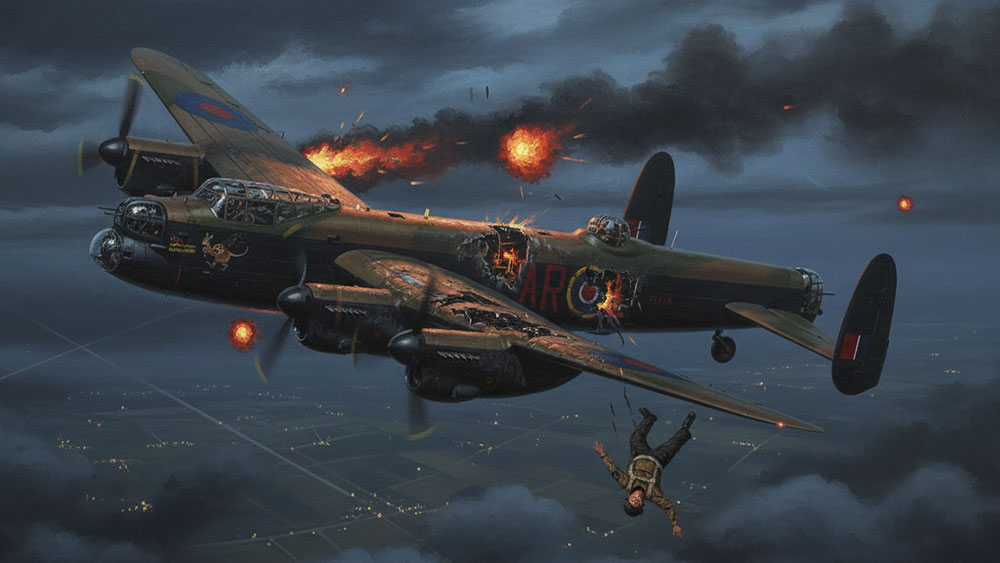
Alkemade was a Royal Air Force rear gunner with 115 Squadron, flying in an Avro Lancaster. On the night of 24 – 25 March 1944, returning from a raid on Berlin, his aircraft was attacked and set on fire. Alkemade tried to reach his parachute, but it became unusable in the flames. He chose to jump rather than burn.
He fell from roughly 18,000 feet and survived, landing in a pine forest with snow on the ground. He suffered comparatively minor injuries. Like Magee, he was captured. Unlike Magee, he had to defend his account under interrogation because it sounded impossible. His story was eventually accepted, and later retellings note that the Germans issued documentation attesting to what had happened.
There are surface similarities, but the contrasts are the point.
The key differences
- Magee was thrown out unconscious: Alkemade made a deliberate decision and jumped. Magee blacked out and went out through the hatch in a spinning aircraft. Those are two very different experiences of “bailing out”.
- Their impacts were different kinds of “not ground”: Magee hit a man-made structure: glass and girders. Alkemade hit landscape: trees and snow. In both cases the fall was broken over distance, not absorbed in a single instant, and that’s likely the common mechanism.
- Their injuries tell you about the landing: Magee’s injuries were severe and surgical. Alkemade’s were relatively light. That doesn’t make one story “better”. It just shows how narrow the margin is. Small differences in angle, speed, and what you hit first can flip survival into death.
- Both became POWs, which is where the story stops being exceptional: Once captured, each man entered a system that processed aircrew into camps and routines. Alkemade’s later association with Stalag Luft III feeds directly into wider public memory, because that camp sits in the same mental drawer as “The Great Escape”. Magee’s captivity is less famous, but no less real.
Why bring Alkemade into Magee’s story at all?
Because it stops Magee’s fall being treated as a freak, one-off “act of God” tale.
What these cases show, when you set them side by side, is that survival from high-altitude falls without a functioning parachute, while vanishingly rare, is not beyond the physical limits of the human body if the final impact is disrupted and spread out. A roof structure can do it. A forest canopy can do it. Snow can do it. None of these guarantees anything.
The comparison also restores the wartime logic. Both men were gunners. Both were positioned in parts of bombers where escape could be slow, awkward, or dependent on a parachute that wasn’t on the body. These aircraft were not designed with crew comfort or easy egress as first priorities. They were designed to carry bombs, fly far, and defend themselves as best they could. The crews adapted around that design.
What we can say with confidence, and what we should treat carefully
There is plenty in both stories that is solid. Names, dates, aircraft types, squadron and group identities, the basic sequence of damage, fall, capture, and liberation.
There is also plenty that is not solid, mainly where later retellings smooth out uncertainty.
The exact height is one example. “About 20,000” becomes “22,000” because round numbers stick. The human mind likes a precise figure, even when the original record was an estimate made under combat conditions.
The “why” is another. People want a single cause: the glass roof, the snow, the trees. In reality it’s usually a chain of small, unrepeatable factors that happen to line up.
If you want to tell Magee’s story honestly, the best approach is to keep the spine of the record intact, explain the aircraft context, his role as a ball turret gunner, and resist turning the rest into folklore.
His survival doesn’t need improving.