By late 1940, the RAF’s battle had shifted. Daylight fighting had eased after the Battle of Britain, but the night war was ramping up fast. German raids continued through the winter, and the RAF’s ability to find and engage bombers in darkness depended on something new, technical, and still unforgiving: airborne interception (AI) radar.
That wider story sits behind a brief, brutal entry in the RAF’s accident records.
Bristol Blenheim Mk IF L6612
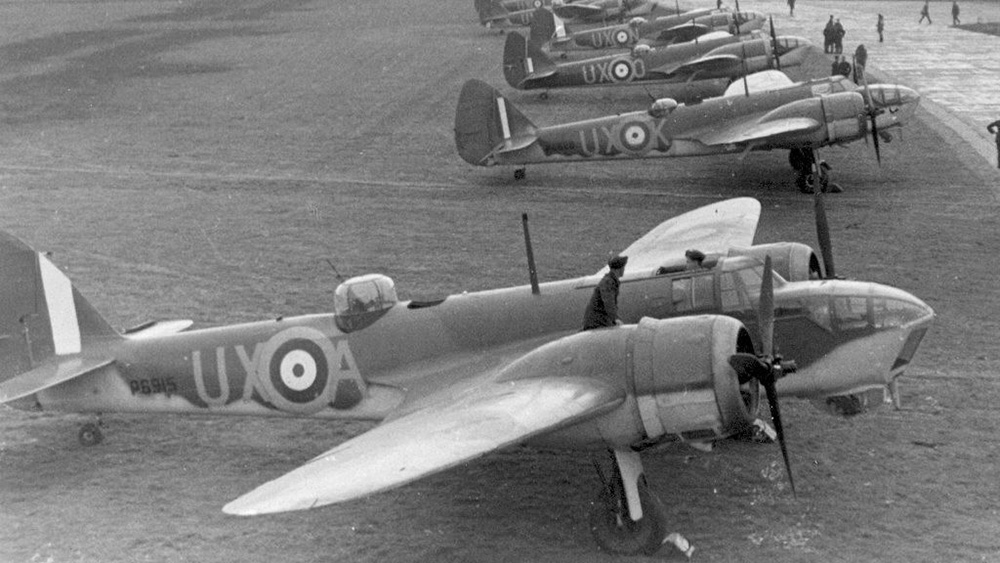
On Thursday 19 December 1940, Bristol Blenheim Mk IF L6612 of No. 29 Squadron RAF took off from RAF Wellingore on a training flight, bound for RAF Digby. During low flying connected with AI radar practice, the aircraft encountered a downdraught near Leadenham, struck trees at the edge of a small wood on the escarpment, and crashed. All four crew were killed.
This is what we can piece together about the flight, the unit, and the men.
The aircraft, the squadron, and the job they were training to do
The Blenheim began life as a light bomber, but the Mark IF was adapted as a long-range fighter and, crucially, became one of the RAF’s early platforms for night fighting and radar trials. No. 29 Squadron was among the units pushing those tactics forward, operating from RAF Digby and its nearby satellites, including Wellingore.
AI radar work in 1940 was still a developing art. Crews had to learn how to work as a team in darkness: ground controllers vectoring fighters into the right patch of sky, the onboard operator interpreting a crude display, and the pilot flying precise headings and heights while trying to keep the aircraft within limits. Training sorties were essential and they were often flown in marginal winter conditions, sometimes at low level, with little room for error.
The flight and the Blenheim crash near Leadenham
The clearest summary of what happened comes from local incident logging: Blenheim L6612 was “caught by a downdraught whilst low flying for airborne intercept radar practice,” struck trees “at the corner of a small wood on the escarpment,” and then crashed into the ground, killing all on board.
Another compiled record places the departure at RAF Wellingore and the intended destination as RAF Digby, consistent with the way Digby operated with satellites under its control.
A downdraught on rising ground is a particularly nasty trap at low level: the aircraft is suddenly forced down, and if there isn’t height in hand, the pilot may not have time or space to trade speed for lift and clear obstacles. That appears to be the core of this accident—an abrupt loss of height at the worst possible moment, on the edge of high ground and trees.
The crew: four stories behind one loss
Sgt Sydney Stokoe (pilot)
Sydney Stokoe was from Gateshead, born 28 December 1915. Before the war he worked as a draughtsman, and he held an Aero Club certificate gained at Newcastle in February 1939—an important detail, because it shows he was already committed to flying before the RAF had fully expanded into wartime scale. ([Battle of Britain Monument][5])
He joined the RAF Volunteer Reserve around August 1939 and was called up on 1 September 1939. By about 1 September 1940 he was with No. 29 Squadron at Wellingore, and he flew his first operational sortie later that month. ([Battle of Britain Monument][5])
He was 25 when he was killed in L6612. His grave is at Heworth (St Mary) Churchyard, County Durham. ([Battle of Britain Monument][5])
Sgt Edwin Jones (air gunner)
Edwin Jones was born in 1913 and came from Askam-in-Furness. He joined the RAF in September 1935 as an aircraft hand, later re-mustering as an airman under training to become an air gunner—one of the many men whose “ground-to-air” journey reflected the RAF’s urgent need to expand aircrew numbers.
By June 1940 he was serving with 29 Squadron at Digby. He was killed in L6612 on 19 December 1940, aged 27, and is buried at Barrow-in-Furness (Thorncliffe) Cemetery and Crematorium.
Sgt Albert Alfred Wilsdon (air gunner)
Albert Alfred Wilsdon was born in Bradford on 22 February 1910. He joined the RAF around 1929–30 and later trained as an air gunner. In July 1937 he married Nellie Leadenham, and the couple had twin sons, Anthony and Terence, born in 1938.
His service with No. 29 Squadron is particularly notable because it links him to one of the squadron’s better-known operational moments. Posted to the unit on 9 August 1940, he flew as gunner with P/O J. R. D. “Bob” Braham and was involved in an interception on 24 August 1940, when their Blenheim engaged a Dornier Do 17; they were later credited with the victory.
Like the others, Wilsdon was killed in the crash of L6612. He is buried in Doncaster (Rose Hill) Cemetery.
Sgt Iorwerth Walter Watkins (observer)
The fourth member of the crew, Iorwerth Walter Watkins, served as the aircraft’s observer. In the Blenheim night-fighter context, that role could encompass navigation and the demanding workload of supporting interceptions—exactly the kind of crew coordination that AI radar training was designed to build.
Watkins was just 19 when he died. CWGC records list him as the son of William and Sarah Jane Watkins of Pontllanfraith, and he is buried at Woodfieldside (Jerusalem) Chapelyard in the UK.
Why this Blenheim crash still matters
It’s easy to treat wartime flying accidents as footnotes compared with combat losses. But for units like 29 Squadron in late 1940, training flights were not routine “hours building.” They were rehearsal for a new kind of fighting, in conditions that were frequently worse than combat: low cloud, poor visibility, winter turbulence, pressure to master unfamiliar equipment, and the constant risk of controlled flight into terrain.
The crash of Bristol Blenheim L6612 speaks to that moment in the air war when technology was advancing quickly, but safety margins – especially at low level – were still thin. The RAF needed these crews to survive long enough to become proficient; on 19 December 1940, four men didn’t get that chance.