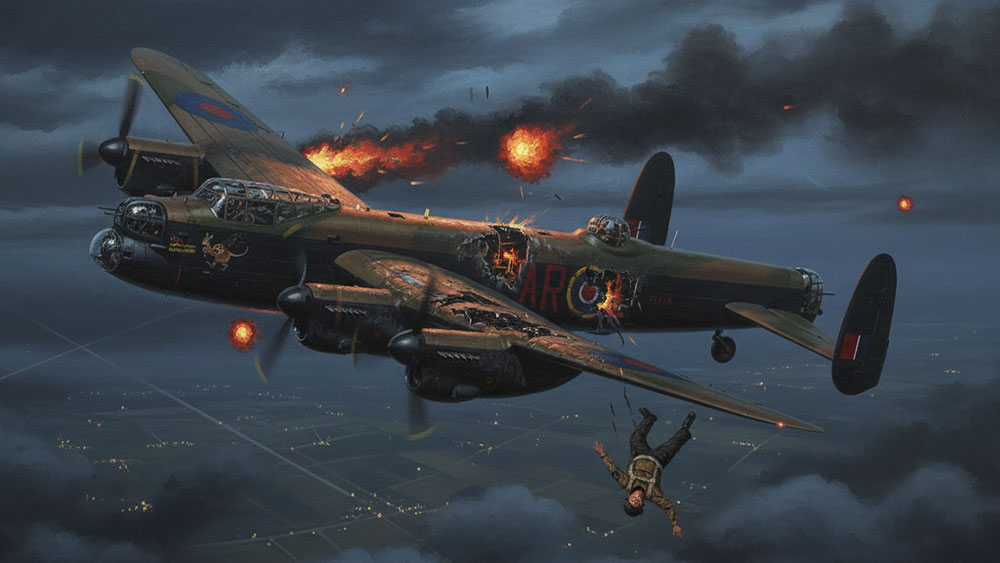

James A. Raley’s WW2 story has been boiled down to a neat line: “the man who fell inside a B-17 tail”. It’s accurate, but it skips the circumstances that made it possible. This wasn’t a lone aircraft limping home. It was a mass-formation mission, flown into cloud over occupied Greece, where heavy bombers could barely see their own wingtips. James Raley survived not because his parachute failed, but because the part of the aircraft he was trapped in behaved, briefly, like a crude glider.
In a 1944 interview, Raley said:
“When the crash occurred 19,000 feet in the air, there was a terrific impact, and I was thrown face down on the floor toward the rear of the fort. I had an immediate sensation of falling as the plane spiraled downward, twisting to the right in a tight circle. My first thought was to grab my parachute and get out of the plane, but the spinning made it impossible for me to move.”
Here’s his story…
James Raley’s fall from a B-17 bomber at 19,000 feet
James Raley was the tail gunner in a B-17F called “Skippy” (serial 42-3098), flying with the 353rd Bomb Squadron, 301st Bomb Group, Fifteenth Air Force.
Piraeus, cloud, and the danger of flying blind
On 11 January 1944, elements of the 301st were tasked with bombing Piraeus Harbour. The bomber stream ran into solid overcast at roughly 18,000 feet. Inside the cloud, formation flying becomes guesswork. Ice builds. Airspeed and spacing start to drift. A crew can do everything “right” and still end up in the wrong place at the wrong moment.
Group and squadron accounts describe how two B-17s from another unit developed engine trouble and, instead of peeling away from the flow, turned into it. The result was a head-on collision and then a chain reaction: aircraft striking aircraft, explosions in the murk, and wreckage falling through cloud for minutes. The losses were heavy.
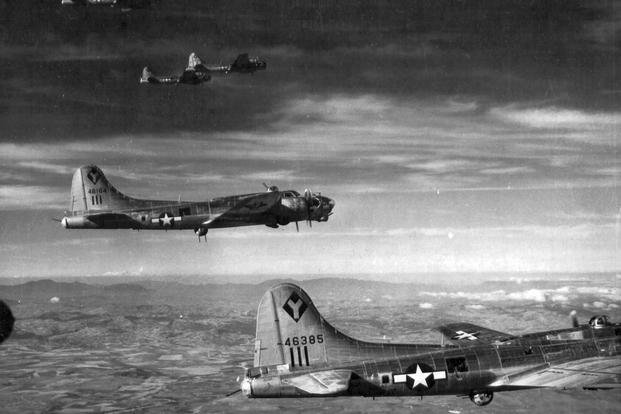
A tail section without an aeroplane
Skippy didn’t simply stagger out of formation or lose control. The collision tore the tail clean away from the fuselage, and Raley was still in it, strapped into the gun position. In an instant the rest of the aircraft was gone, and he was left in a severed section of aluminium, plexiglass, guns and empty air.
This is where the story turns from the horrific to the improbable. Multiple accounts note that the detached tail didn’t plunge straight down in a flat spin. It fluttered. The balance of weight and drag let it settle into a slow, unstable descent rather than a direct, murderous drop. James Raley later described a spinning fall that eased into something like a falling leaf.
Raley later recounted how he said prayers during the fall.
“I must have been spiraling downward for 10 to 15 minutes,”
It was his thirteenth mission.
There’s a small, very human moment that keeps turning up in retellings. When the tail section finally came to rest, Raley opened an internal door expecting the rest of the aeroplane to be behind it. There was nothing there. Just open air and the ground far below.
Trees, impact, and a second problem: where he’d landed
The tail hit in a clump of trees. That mattered as much as the strange “flutter” on the way down. Branches and trunks did what crash barriers do. They lengthened the stop and took the edge off the impact. James Raley’s injuries, by the standards of what had just happened, were surprisingly light.
Then came the part that doesn’t fit into a single sentence. He was on the ground in German-occupied Greece. Being alive was only step one.
In Raley’s own words, the tail he was in “landed in a clump of small trees which broke the fall sufficiently to permit me to escape practically unscathed.” That bought him the one thing he needed first: time. He got himself out of the wreckage and into the surrounding hills, moving in a way that tells you plenty about the terrain and his condition. “I half-climbed, half-fell from tree to tree down the near perpendicular mountainside,” he wrote.
He was alone, injured, and in occupied Greece. After a few hours he heard voices and took the risk of shouting. “He shouted and a handful of Greek men came and helped him down the mountain to a monastery,” one account says, placing him under cover by nightfall. Another version carries the same thread, describing how he “was found by Greeks who carried him to the Vlasias Monastery, arriving late that evening,” and records his need to get the story out: “I have to tell somebody what happened to me.”
From that point, the outline stays clear, but the day-to-day detail is harder to pin down in the material that circulates most widely. What does come through is that it wasn’t a straight run to safety. There were “many ‘false starts’” before he and those helping him were finally evacuated from Greece on 3 April.
James Raley was the only survivor from his crew:
- CPT Robert W. Coen, Jr.
- 2LT Henry J. Sudol
- 1LT Bruce E. Hicks
- 1LT Robert B. Fasset
- S/SGT John A. Kemmler
- T/SGT Lucio A. Pittoni
- S/SGT Leonard E. Matkey
- S/SGT Eldon C. Steerman
- SGT James A. Raley
The hard facts that hold the story in place
For readers who prefer the story pinned to a few solid points, the spine is straightforward:
- Aircraft: B-17F *Skippy*, serial 42-3098
- Unit: 353rd Bomb Squadron, 301st Bomb Group (Fifteenth Air Force)
- Date: 11 January 1944
- Circumstance: mid-air collision during the Piraeus mission
- Outcome: Raley listed as the sole survivor, recorded as having evaded
Why Raley’s all survival still gets talked about
It’s tempting to shrug and call it luck. But James Raley’s survival was luck with a mechanism. A particular kind of break-up of the B-17 bomber produced an accidental airframe with enough drag and lift to slow the fall. A stand of trees finished the job. After that, survival became an old-fashioned wartime problem: a single airman on enemy-held ground, alone, without his crew, trying to stay free.
That’s why this episode has lasted. It’s really two stories welded together: a disastrous formation collision in cloud, and one man’s escape from the part of the aircraft that shouldn’t have brought anybody down alive… and incredibly, a similar thing also happened to a rear gunner named Eugene Moran.